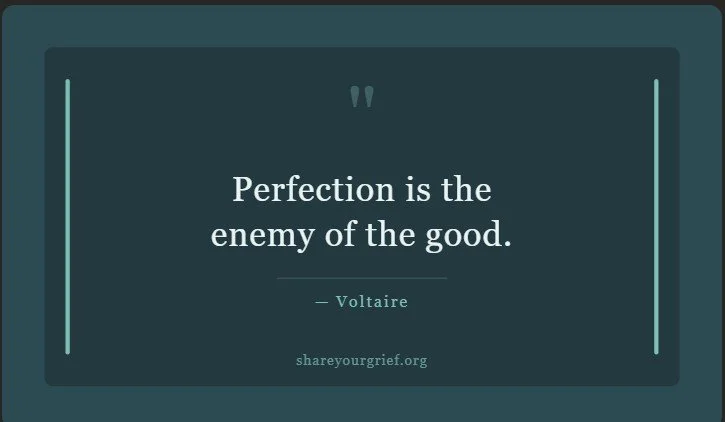
Perfectly Anxious: Understanding the Link Between Perfectionism and Anxiety
There is a particular kind of exhaustion that comes not from doing too much, but from never feeling like what you do is quite enough. If you have ever finished a project, received praise, and immediately shifted your focus to what you could have done better, you may be familiar with the quiet tyranny of perfectionism.
Perfectionism and anxiety are close companions — and understanding why can be the first step toward loosening their grip.
The Perfectionism-Anxiety Connection
Perfectionism is not simply having high standards. Researchers distinguish between adaptive perfectionism — a healthy pursuit of excellence — and maladaptive perfectionism, characterized by a fear of failure, harsh self-criticism, and an all-or-nothing thinking style. It is this latter form that fuels anxiety.
The mechanism is straightforward: perfectionists set standards that are, by definition, nearly impossible to meet. When those standards are not met — and they rarely are — the perfectionist interprets the shortfall not as a normal part of being human, but as evidence of personal inadequacy. This creates a chronic state of threat that the brain interprets as danger, activating the same anxiety response as a physical threat. The result is a relentless cycle of striving, falling short, and self-criticism that keeps the nervous system in a near-constant state of alert.
Where Does Perfectionism Come From?
Perfectionism rarely develops in a vacuum. Research consistently points to several contributing factors:
Early experiences of conditional approval — growing up in an environment where love or praise felt contingent on achievement can teach a child that their worth is earned, not inherent.
A response to uncertainty or chaos — for some, perfectionism develops as a coping mechanism. If I can just control my performance, I can control outcomes. It is an understandable strategy that ultimately creates more anxiety than it resolves.
Cultural and social messaging — we live in a culture that celebrates productivity and achievement while stigmatizing failure. Social media, with its curated highlight reels, amplifies the illusion that everyone else is performing life flawlessly.
Temperament — some people are simply wired with a stronger sensitivity to mistakes and a heightened need for order and predictability.
Tools for Loosening Perfectionism's Grip
The goal in managing perfectionism is not to abandon your standards — it is to build a healthier relationship with imperfection.
Practice self-compassion over self-criticism. Research by Dr. Kristin Neff demonstrates that self-compassion — treating yourself with the same kindness you would offer a struggling friend — is more effective at motivating change than self-criticism, which tends to increase shame and avoidance.
Challenge all-or-nothing thinking. Perfectionism thrives on binary thinking: success or failure, good enough or worthless. When you notice this pattern, try asking yourself, "Is there a middle ground here?" A project that is 80% of what you envisioned is not a failure — it is a completed project.
Set process goals rather than outcome goals. Instead of "I need to do this perfectly," try "I will give this my genuine effort for the time I have." Shifting focus from outcome to process reduces the anxiety that comes from fixating on results you cannot fully control.
Embrace "good enough." Psychologist Barry Schwartz's research on decision-making introduced the concept of "satisficing" — choosing an option that is good enough rather than optimal. Perfectionists are maximizers who exhaust themselves searching for the best possible outcome. Learning to satisfice in lower-stakes situations is a skill that can be practiced and gradually expanded.
A Note on Perfectionism and Grief
For those who are grieving, perfectionism can add an invisible layer of suffering. Perfectionists often feel they should be grieving "correctly": their emotions are too much or not enough, that they should be further along by now, or that they are somehow failing at the very human act of mourning. Work adds its own version of this pressure, a place where grieving 'correctly' can start to look like staying composed enough to get through the day. If this resonates with you, please know that there is no right way to grieve. Grief, like life, is beautifully and necessarily imperfect.
Reaching out for help is often the hardest step — especially when part of you worries that your struggles aren't "bad enough" to warrant it. They are. I offer a free 15-minute consultation where we can simply talk about what you're experiencing. You can schedule that here.