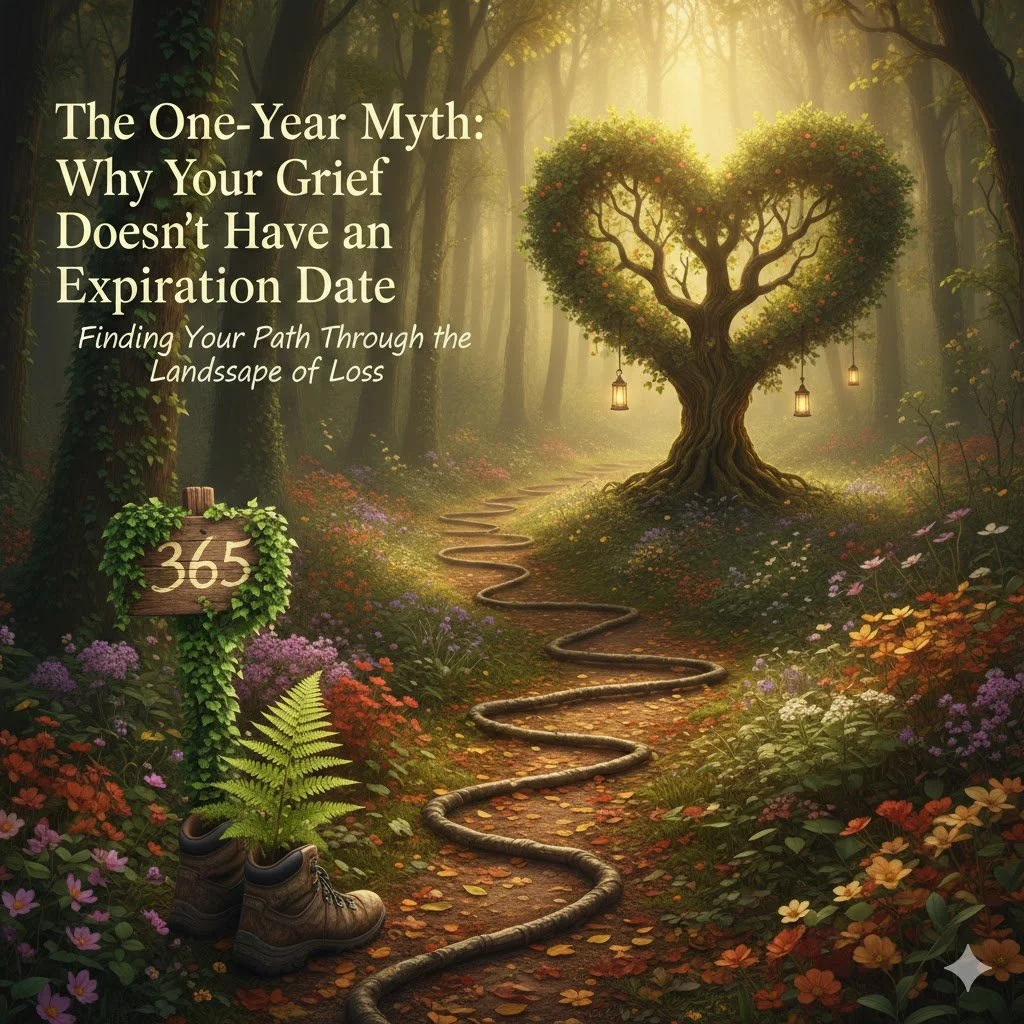
The One-Year Myth: Why Your Grief Doesn’t Have an Expiration Date
One of the pernicious myths regarding grief is that something happens at the end of the first year following a loved one’s death where the griever miraculously feels “better.” When this does not occur, they may look at the calendar with a sense of impending failure, asking some version of the same question: “Why don't I feel better yet? Am I doing this wrong?”
We have a cultural obsession with the "one-year" milestone. We treat it like a finish line—a magical threshold where the heavy lifting of mourning should be complete and we should "return to normal."
But here is the clinical truth: The one-year mark is often one of the hardest parts of the journey, not the end of it.
Why the "One-Year" Timeline is a Fiction
The idea that grief fits into a neat 365-day box is not based on human psychology; it’s based on a calendar. In reality, the first year is often spent in a state of "survival shock." Your brain is busy rewiring itself to a world that no longer contains your loved one.
When that first anniversary hits, the "protection" of shock often wears off. You aren't "backsliding" if you feel more pain at fourteen months than you did at four; you are simply more present for the reality of the loss.
Grief is Not a Task to Finish
Instead of a staircase we climb (where the top is "recovery"), think of grief as a landscape you learn to live in.
You don’t "get over" it: You grow around it.
Progress isn't linear: It looks more like a scribble than a straight line.
The "Second Year" is real: Many people find the second year more challenging because the initial casseroles have stopped arriving, the check-in texts have slowed, and the permanent nature of the loss finally sinks in.
If you are past the year mark and still feeling the weight of your loss, you aren't "stuck." You are grieving. And grieving is a testament to the depth of the love that preceded it.
A Note on the "No Major Decisions" Rule
You’ve likely heard the well-meaning advice: “Don’t make any major life changes in the first year.” While this is designed to protect people from impulsive choices made in a while we’re experiencing brain fog, it isn't a universal law.
For some, staying in the family home is a source of daily trauma. For others, a career change or a move provides a necessary "fresh start" that aids their healing. Clinical wisdom suggests we should pause and evaluate, but we shouldn't paralyze ourselves. If a decision is born out of a need for safety, peace, or survival, "waiting out the clock" isn't always the healthiest choice. Sometimes, the most empowered thing you can do is trust your own internal compass, even when the world tells you to wait.
If what you've read here resonates, you don't have to keep navigating this alone. I offer a free 15-minute consultation so we can talk about what you're carrying and whether grief therapy might help. There's no pressure and no commitment — just a conversation. Schedule here