What If Your Depression Is Trying to Tell You Something?
There is a story most of us have been told about depression. It goes something like this: depression is a brain disease. Something in your chemistry is off. You were born with a vulnerability, or you inherited it, and now it is expressing itself. The solution is to correct the imbalance, usually with medication, and get back to functioning.
It is a tidy story. It is also, increasingly, one that the research does not support.
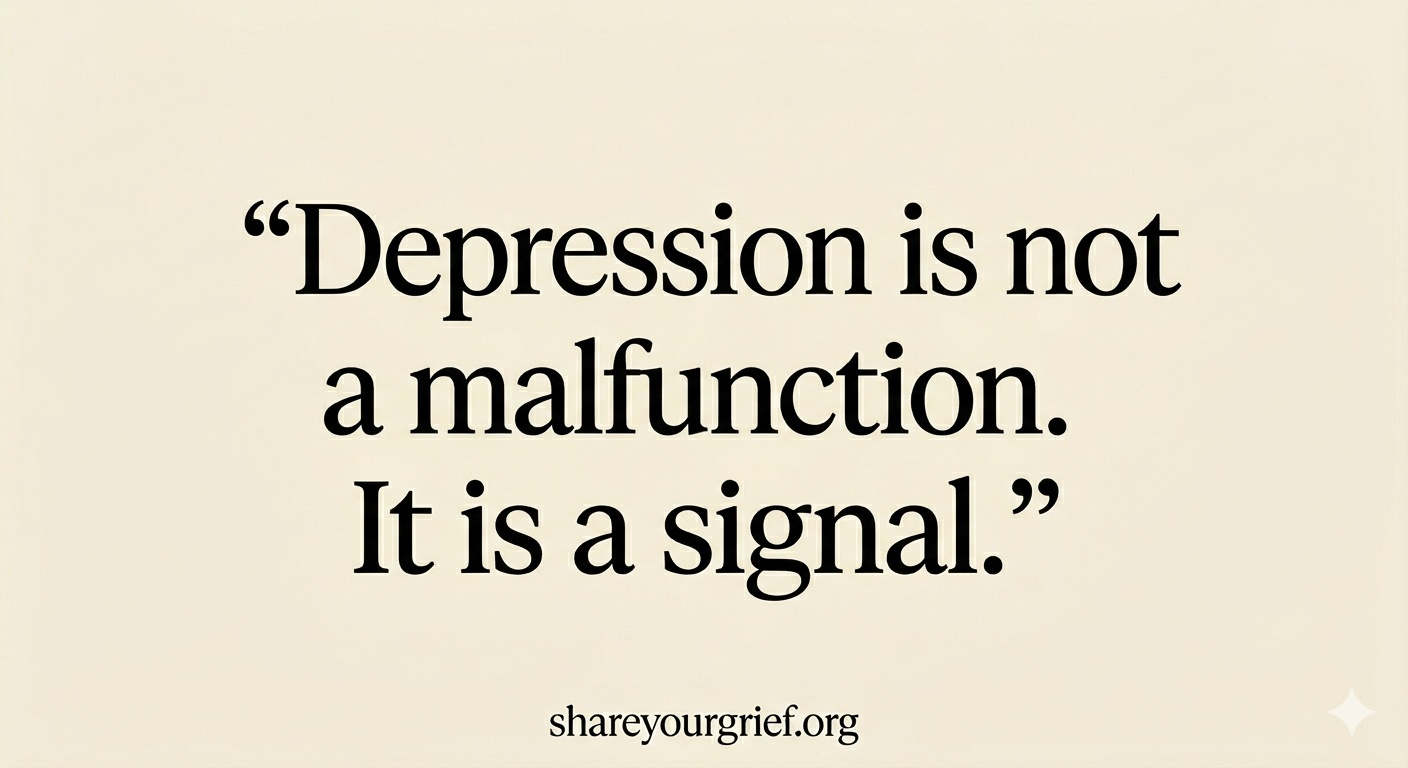
This post is not an argument against medication, and it is not a dismissal of biology. It is an invitation to consider a different framework, one that many of my clients find more honest, more hopeful, and more useful: the idea that depression is not a malfunction. It is a signal.
The Collapse of the "Chemical Imbalance" Story
For decades, the dominant explanation for depression was straightforward: low serotonin causes depression, and antidepressants work by raising it. This idea was so widely repeated, in pharmaceutical ads, in doctors' offices, in popular books, that most people simply accepted it as established science.
It wasn't. In 2022, a comprehensive review published in the journal Molecular Psychiatry, led by researchers at University College London, examined decades of studies on serotonin and depression and found no consistent evidence that low serotonin levels cause depression. The researchers were not fringe critics. They were not arguing that antidepressants are useless. They were documenting what many researchers had privately understood for years: the chemical imbalance story was a significant oversimplification, one that had been marketed aggressively but never actually proven.
What this means, practically, is that if you have ever felt vaguely defective, as though your brain were simply broken in some fundamental way, that story may have done you a disservice. Depression is real. The suffering is real. But "your serotonin is low" is not a satisfying or accurate explanation for why you feel the way you do.
So if it is not a chemical imbalance, what is it?
Depression as a Signal
In 2023, researchers at the University of Michigan published a randomized controlled trial testing what happens when people are given a different framework for understanding their depression. Instead of describing depression as a disease or disorder, the "signal" framing presented it as something that serves a function, a meaningful response to something in a person's life or history that needs attention. People who received the signal framing reported less self-stigma and more hope for recovery than those given the standard disease explanation. The framing mattered. How we understand our depression shapes how we relate to it, and how much agency we feel in addressing it.
This idea, that depression functions as a signal rather than a malfunction, is not new in clinical circles. It draws on evolutionary psychiatry, which asks: why would a response this powerful and this universal exist if it served no purpose? The honest answer is that depression, in many of its forms, appears to be the mind and body's way of saying: something here needs to change. Something here has been injured. Something here is asking for your attention.
The question worth sitting with is not "what is wrong with my brain?" It is "what is my depression trying to tell me?"
Two of the Most Common Things It Points To
In my practice, depression rarely arrives out of nowhere. When I sit with clients and we slow down enough to look beneath the symptoms, two things come up again and again.
The first is trauma, particularly experiences from early in life that shaped how a person learned to see themselves and the world. The research here is striking. Studies consistently show that adverse childhood experiences, including abuse, neglect, and household instability, significantly increase a person's lifelong vulnerability to depression. The connection is not merely statistical. Early experiences of being unsafe, unseen, or unloved leave traces in the nervous system and in the stories we carry about our own worth. Depression, in many of these cases, is not a brain disease. It is the body's long memory of something painful that was never fully addressed.
The second is the inner critic: that relentless internal voice that tells you that you are not enough, that you have failed, that other people are managing life better than you are. Research published in 2024 found that working directly with self-criticism in depressed patients produced significant improvements in depressive symptoms, self-compassion, and self-esteem. This tracks with what I see clinically. For many of my clients, depression is not a mood that descended from nowhere. It is the cumulative weight of years of harsh self-judgment, the exhaustion of living under a verdict that is never quite "good enough."
Paul Gilbert, the psychologist who developed Compassion Focused Therapy, has spent decades studying the relationship between self-criticism and depression. His central insight is that the inner critic was not born cruel. It developed, usually in childhood, as a way to stay safe, to meet high expectations, to avoid punishment or rejection. It was adaptive once. Over time, it becomes the thing that is making you sick.
What It Means If Depression Is a Signal
If depression is a signal, then the job is not simply to silence it. The job is to get curious about what it is pointing toward.
This does not mean refusing medication if medication would help. Signals can be so loud they make it impossible to function, and sometimes we need support to turn the volume down enough to do the deeper work. But medication that quiets the signal without ever asking what it was signaling is, at best, a partial answer.
It also means something important about how you relate to yourself while you are in it. Depression is not evidence that you are broken. It is not proof that your brain is defective or that you are constitutionally ill-suited for the life you are trying to live. It may be evidence that something happened to you that left a mark, or that you have been living under a weight of self-judgment that no person was designed to carry indefinitely.
That is a very different story. And in my experience, it is a more useful one, because it opens a door that the disease model tends to close. If depression is a signal, there is something to listen to. There is something to address. There is a path forward that is not just management, but genuine change.
A Note on Getting Help
Getting curious about what your depression is pointing toward is not something you have to do alone. In fact, it is often easier with a guide, someone who can help you slow down, look beneath the surface, and begin to understand what your inner world has been trying to say.
If you have been carrying depression and wondering whether there might be more to it than a chemical imbalance, I would be glad to talk. You can schedule a free 15-minute consultation at shareyourgrief.org. No pressure, no commitment. Just a conversation.