Who Are You Now? What Loss Does to Identity
There is a question that surfaces for many grieving people, one that can feel strange or even embarrassing to say out loud: who am I now?
It shows up in small, disorienting moments. Not knowing what to make for dinner because you have not had to choose alone in years. Struggling to picture your own future because it was built around a life that included someone who is no longer in it. Feeling unmoored in a way that has nothing to do with sadness and everything to do with not quite recognizing yourself.
If this is familiar, you are not being fragile. You are encountering one of the most predictable and least talked about features of significant loss.
The Self We Build in Relationship
We build our identities with other people, not in isolation. This is not a poetic observation; it is developmental fact. From childhood onward, our sense of who we are is shaped by the people closest to us, by how they see us, by what we become in their presence. By the time a relationship has years or decades behind it, the line between "who I am" and "who I am with this person" can be genuinely hard to locate.
So when someone central to that self dies, the disruption is not a side effect of grief. It is grief, expressed at the level of the self. None of this means something is wrong with you. It means your identity is doing exactly what identity does when a foundation it was built on disappears.
The Beliefs You Did Not Know You Had
Part of what makes this so disorienting is that most of us do not know these assumptions are there until loss breaks them open. Psychologist Ronnie Janoff-Bulman's research on what she calls the assumptive world identifies a few beliefs that quietly undergird most people's sense of security: that the world generally makes sense, that it is not senselessly cruel, that we are safe.
We rarely notice these beliefs consciously. We simply live as though they are true until something happens that makes them impossible to hold onto. Major loss, especially sudden loss, can shatter them at the root. That shattering is part of why grief can feel disorienting well beyond sadness. It is not only your heart that is hurting. It is your whole framework for how the world works.
The Questions That Surface
Some of the identity questions grief raises are immediate and practical. Am I still a wife if my husband has died? A father if my child is gone? These titles carry so much of who we understand ourselves to be and after a loss they can feel like they belong to a life that no longer exists even while the relationship itself still feels present in other ways.
Other questions arrive more slowly. What do I do with the years I assumed I had? Who am I outside the role that organized so much of my time and attention? What do I actually want now that the future I was building has to be reimagined from a different foundation?
There is no need to answer these quickly and trying to usually backfires. This is not something you decide. It is something you discover gradually by living a life that has no precedent for you yet.
What This Growth Actually Looks Like
Carrying a lost identity forward rarely happens as one clear moment of clarity. It tends to show up in a few different ways.
Some of it happens through carrying the person forward. Taking on values, habits, or ways of being that belonged to someone you lost is not just a way of remembering them. It is a way of living alongside a self that includes them.
Some of it happens through discovering capacities you did not know you had. Loss can push people into skills and roles they never needed before: managing finances for the first time, taking on new tasks or chores, traveling alone. These are not just coping mechanisms. They are new parts of who you are.
Some of it happens through renegotiating relationships. Friendships sometimes fade after a death, not from unkindness but because they were built around a context that no longer exists. New connections often form in their place, sometimes with people who understand this particular kind of loss.
And some of it, the hardest part to describe, happens simply through the accumulation of days in which you were still here, still making small decisions, still choosing what comes next.
A Note on "Finding Meaning"
You may have heard that loss can lead to what researchers call post-traumatic growth: more appreciation for life, deeper relationships, a clearer sense of purpose. This does happen for some people and it is real when it does.
But it is not a requirement and it cannot be forced. If your loss has not produced a lesson you can name or a purpose you can point to, you are not doing grief wrong. You are simply living with a loss which is its own form of work.
Questions Worth Sitting With
You do not need to answer these. They are meant to be companions, not assignments.
What did I understand about myself only in relation to this person and how do I relate to that part of myself now?
Is there a value or way of being of theirs that I notice showing up in me?
What is one small capacity I have discovered in myself since this loss?
Where do I feel most like myself these days, even briefly?
A Final Word
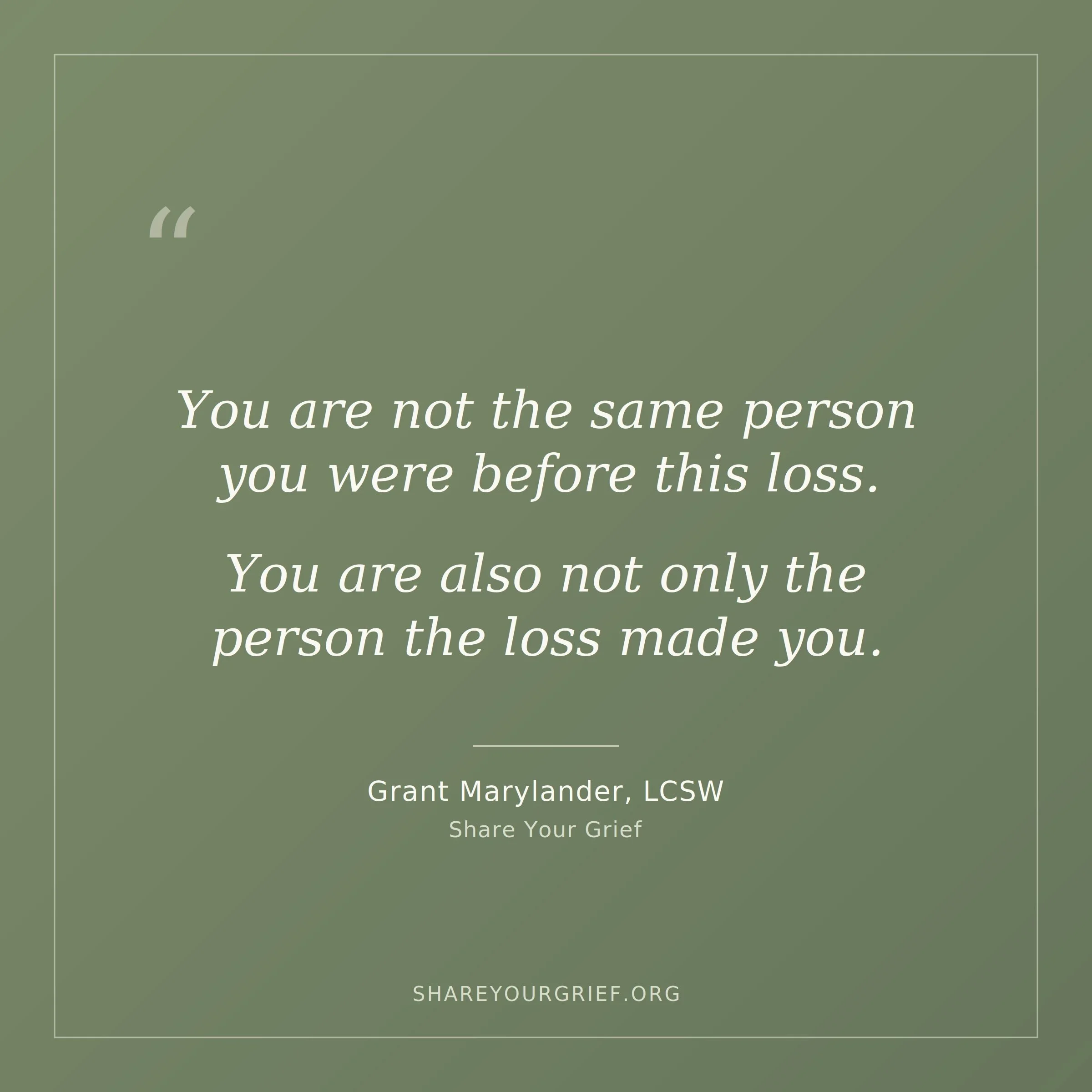
You are not the same person you were before this loss. You are also not only the person the loss made you. You are in the process of growing around both, carrying what remains while living alongside what has changed. That process is slow by nature and that is not a failure to move forward. It is what integrating a loss actually looks like.
If this resonates and you would like support working through it, I offer a free 15-minute consultation. No pressure, no commitment. Just a conversation.