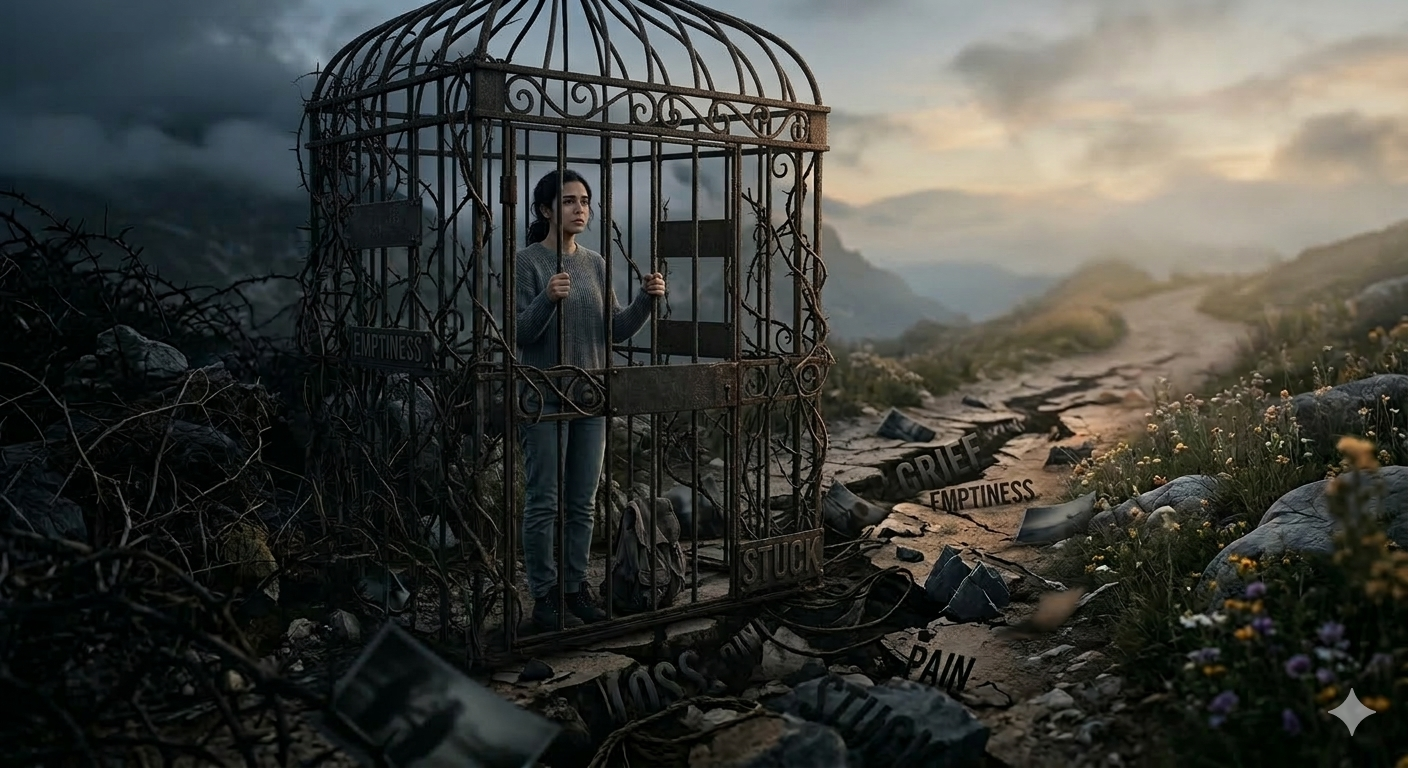
Am I Stuck? When Grief Becomes a Cage
Grief is not a disease, and that truth does not change simply because you continue to carry it beyond an artificial timeframe. Whether it has been one year or ten, the presence of grief is not a symptom to be cured, but a reflection of a bond that continues to exist. We must be careful not to mistake the enduring nature of grief for a psychological failure.
At the same time, it is possible for the grieving process to lose its fluidity. There is a point where grief stops being a heavy, somber companion on your journey and starts becoming a cage: a place where the walls feel fixed and the exit feels barred. In the clinical world, we have defined this specific experience of "cage-like" or “stuck” grief: Prolonged Grief Disorder (PGD).
When Grief Becomes "Prolonged"
The inclusion of PGD in the DSM-5-TR was controversial, and for good reason. Grief is the natural reaction to loss. As such, pathologizing grief can be injurious and another way our society stigmatizes grief and grievers. There are times, however, where the PGD diagnosis allows us to identify when grief has derailed and our grief reactions are entrenched to the point that we cannot pursue a meaningful life.
For adults, we cannot diagnose someone with PGD within the first 12 months of the loss (for children this time period is 6 months). PGD is characterized by a persistent longing for the deceased or a preoccupation with thoughts and memories of the person who died. Beyond that, we look for "traffic jams" or “derailers” that occur nearly every day, such as:
Identity Disruption: Feeling as though a part of oneself has died.
Avoidance: Intense efforts to avoid reminders that the person is gone.
Emotional Numbness: An inability to experience positive emotions.
Life Interruption: Significant difficulty engaging with friends, interests, or planning for the future.
The Distinction: Stuckness vs. Integration
The difference between PGD and "regular" (though painful) grief is often one of stagnation versus movement. PGD feels like being caught in a circular storm where our acute grief persists long after the loss occurred.
Integration, by contrast, feels like a slow, erratic tide. If you feel like your grief hasn’t shrunk, you’re right; it hasn’t. But you aren’t "stuck" just because the pain remains the same size. Think of your grief like a stone in a jar. In the beginning, that stone fills the entire jar. As time passes, the stone doesn't get smaller, but the jar—your life, your hopes for the future, your capacity for joy—starts to grow larger around it.
Questions for Reflection: Identifying Your Growth
When that "stuck" feeling becomes overwhelming, take a moment to look at the landscape of your life. These questions can help you notice the subtle shifts of integration:
The "And" Factor: Can I hold two seemingly opposite things at once? Am I able to feel a moment of beauty and the weight of my loss in the same afternoon?
The Shape of the Day: Is my grief an all-consuming fog, or is it a heavy backpack that I am learning to wear as I go about my day?
The Narrative Shift: When I think of them, am I beginning to have "visits" from happier memories rather than just the trauma of the end?
The Quiet Growth: In what ways has my perspective on compassion or "what matters" expanded because of this loss?
A Final Thought
You aren't a project to be finished or a problem to be solved. You are a person who has been changed by a profound loss. Integration isn't the absence of pain; it’s the presence of the loss within a functioning, meaningful life. If you still feel the weight, it doesn't mean you’re standing still: it means you’re carrying something significant as you move forward.
Grief is not something you have to figure out on your own. If you're in the thick of it right now — exhausted, overwhelmed, or just unsure what you're even feeling — I'd be honored to sit with you in it. Reach out for a free 15-minute consultation. Let's talk.