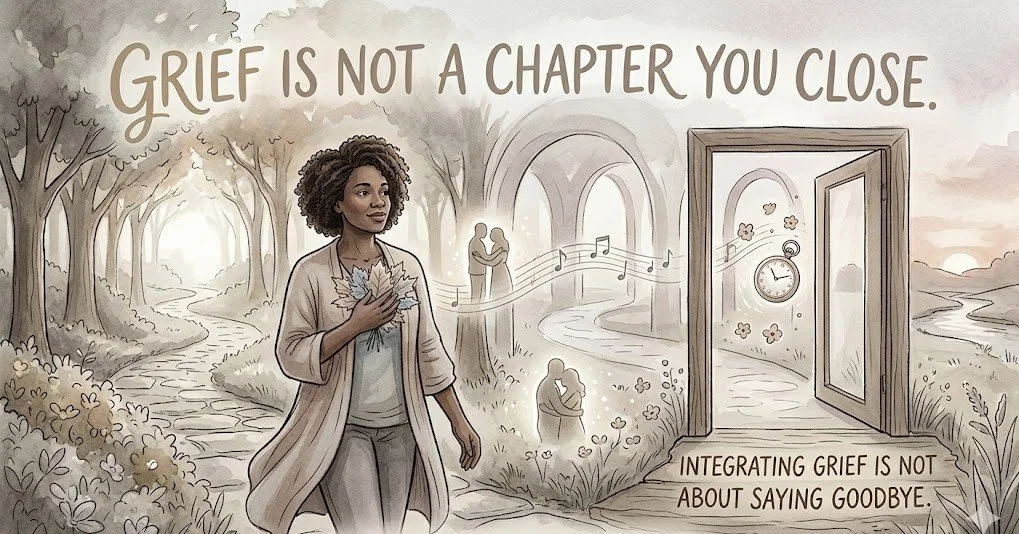
We are often told that the goal of grieving is "closure." The word itself suggests a neat and tidy conclusion—a door that swings shut, a book that is finished, a chapter that is permanently left behind. Friends and family might use this word with the best of intentions, hoping for the day you can finally "move on" and return to the person you were before.
But for those who have lived through deep loss, the word closure often feels like an insult. It implies that if we just work hard enough, we can somehow sever the bond with the person we lost.
Why Closure is a Cultural Fiction
The reality is that human beings are not designed for closure. Our brains are hardwired for attachment. When we love someone, they become part of our internal map—their voice, their values, and their presence are woven into our own identity. Death ends a life, but as pioneer Pauline Boss famously argued, it does not end a relationship.
Seeking closure is often an exercise in frustration because it sets up a false finish line. When you inevitably feel a wave of grief years later—triggered by a song, a scent, or a milestone—you may feel like you’ve "failed" at healing. In truth, that wave isn't a sign of failure; it’s a sign of the enduring nature of love.
Moving Forward, Not Moving On
If the goal isn’t closure, what is it? In grief therapy, our goal is integration: learning to live with our loss and pursue a life that is meaningful to us.
Instead of trying to close a door on the past, we learn to carry the absence with us. We move forward with our grief, not away from it. This is often called "Continuing Bonds." It means finding a new way to relate to the person who died—perhaps through rituals, through living out the values they taught us, or simply by acknowledging that they are still a part of our "inner committee."
Letting Go of the Pressure
If you are waiting for a day when the loss no longer matters, you are waiting for a day that will never come—and that is actually okay. You don't need to "resolve" your grief to live a beautiful, meaningful, and even joyful life.
Integrated grief is not about the disappearance of the pain; it is about the expansion of your world around that pain. You are allowed to be a person who carries this absence forever. You are allowed to keep the door open.
Grief is not something you have to figure out on your own. If you're in the thick of it right now — exhausted, overwhelmed, or just unsure what you're even feeling — I'd be honored to sit with you in it. Reach out for a free 15-minute consultation. Let's talk.