Anger in Grief
When someone you love dies, the world expects you to be sad. Sadness makes sense to people. It is visible, it is legible, and it fits the cultural script. What the world is far less prepared for is the anger.
And yet anger is one of the most common emotions in grief. Many of my clients are surprised by it, even frightened by it. They feel furious at the person who died for leaving them. They feel rage at the doctors, the universe, the friends who said the wrong thing. Sometimes the anger has no clear target at all, just a heat that rises without explanation and burns without a source. And underneath the anger, almost always, is the fear that feeling it makes them a bad person.
It does not.
Why Anger Makes Perfect Sense
Grief researchers have long recognized anger as a central, not peripheral, feature of mourning. Dr. J. William Worden, whose four tasks of mourning remain one of the most clinically grounded frameworks for understanding loss, identifies anger as a normal and expected response to bereavement. It is not a sign that something has gone wrong in your grieving. It is often a sign that it is going right.
To understand why, it helps to think about what loss actually does to us. When someone we love dies, we lose not just a person but a future, a sense of safety, a set of assumptions about how the world is supposed to work. That disruption is not just sad. It is threatening. And when we feel threatened, we get angry.
From a neurological perspective, anger is often a secondary emotion, one that arises in response to something more vulnerable beneath it. Fear. Helplessness. The raw exposure of loving someone and losing them anyway. Anger is, in many ways, the nervous system's preferred alternative to powerlessness. It is energy where grief is collapse. It is movement where loss is stillness. And for many people, it arrives before they have the language for what else they are feeling.
The Targets Are Many, and Often Surprising
One of the things that makes grief anger so disorienting is how many directions it can point at once.
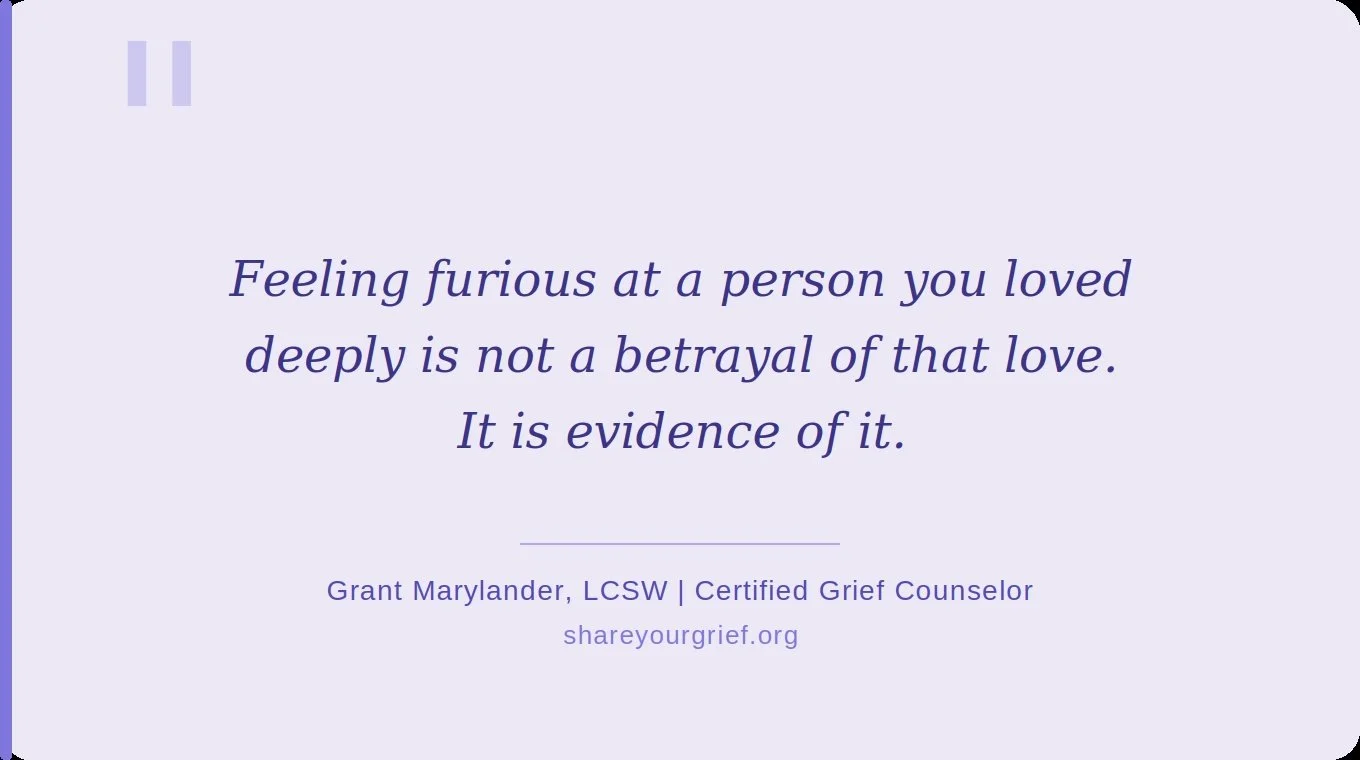
Some people feel anger at the person who died. This is particularly common after a death that felt preventable, a suicide, an overdose, an accident, or a person who refused to see a doctor until it was too late. The anger makes sense: they left. They made choices that took them away. Even when those choices were driven by illness or by forces beyond their control, the loss can feel like abandonment. Feeling furious at a person you loved deeply is not a betrayal of that love. It is evidence of it.
Others feel anger at the people around them. At the friend who disappeared. At the relative who said the wrong thing. At the colleague who seemed to move on immediately. Grief is relational, and the ways others fail us in our loss are real and often worth acknowledging. The sting of those failures can linger long after the initial weeks of mourning.
Some feel anger at God, or at a universe that allowed this to happen. Some feel anger at themselves, looping through the "if onlys" in search of the place where they could have changed the outcome. Some feel anger and cannot name its source at all. Just a background heat that rises at unexpected moments and leaves them feeling ashamed.
All of these are normal. None of them make you a bad person.
Where the Shame Comes From
Grief anger is one of the most poorly supported emotions in our culture. We are comfortable with tears. We are less comfortable with rage, particularly when it is directed at someone who has died or at the people trying to help.
This discomfort has consequences. Many grievers learn quickly to hide their anger, or to express it in indirect and often self-destructive ways. They snap at people they love. They withdraw. They work too much or drink too much or spend too much, anything to channel the energy somewhere it will not make others uncomfortable.
What gets lost in this suppression is the information the anger was carrying. Anger in grief almost always has something to say. It may be pointing toward a genuine loss of trust, a relationship wound that deserves attention, or a place where the mourner needs to set a limit or ask for something they are not getting. Suppressing it does not resolve any of those things. It just drives them underground.
Working With the Anger, Not Against It
The goal is not to eliminate grief anger. The goal is to understand it well enough to work with it.
The first step is simply allowing it to exist. This sounds obvious and is harder than it sounds. Many grievers have spent months or years telling themselves they should not feel this way, that it is wrong or selfish or ungrateful. Getting curious about the anger, rather than immediately judging it, is often the beginning of something useful.
The second step is to look beneath it. When you notice the anger rising, it can help to ask: what else is here? Underneath the fury at your brother for not being there when your mother died, there may be grief about the relationship itself, or fear about who carries the family now. Underneath the rage at a doctor's missed diagnosis, there may be a devastating sense that the world is not as safe as you believed. The anger is real. But it is often pointing toward something that also deserves attention.
The third step is to find expression that is neither suppression nor explosion. Physical movement can help: anger is energy, and the body often needs somewhere to put it. Writing, particularly unsent letters to the person who died or to the people who failed you, can create a container for things that need to be said without requiring you to actually say them. In therapy, anger is something we can sit with carefully and follow to its source.
A Note on Anger and Guilt
Anger and guilt are close companions in grief, and they frequently travel together. The person who feels furious at a loved one who died by suicide may also feel crushing guilt for having felt that anger at all. The person who is angry at the doctors may also feel guilty for not having pushed harder or asked the right questions.
If that combination is familiar to you, please know this: feeling angry does not mean you did not love the person. It does not mean you are glad they are gone. It does not mean anything, except that you are a human being responding to an unbearable loss in one of the most human ways possible. The anger and the love can coexist. They almost always do.
Getting Support
Grief anger can be one of the loneliest parts of loss, precisely because it is the part people feel least able to share. If you are carrying anger alongside your grief and not sure what to do with it, therapy can be a place to bring it without having to manage how it lands on someone else.
You do not have to figure this out alone. If you would like to talk, I offer a free 15-minute consultation at shareyourgrief.org. No pressure, no commitment. Just a conversation.