When Thoughts Feel Like Monsters: A Different Way to Relate to the Mind
There is a particular kind of suffering that happens when we go to war with our own thoughts.
You know the loop. The thought arrives, sharp and uninvited, and then comes the attempt to argue it away, suppress it, distract from it, or convince yourself it is not true. And for a moment, maybe it works. But the thought comes back, often louder, and now you are exhausted from the fight as well as the original fear.
Grief and anxiety are full of these thoughts. I will never feel okay again. Something bad is about to happen. I am not enough, and eventually everyone will see it. They arrive without warning and carry a weight that can feel unbearable.
What if the problem is not the thoughts themselves, but the way we relate to them?
The Mind as a Storyteller
One of the central ideas in Acceptance and Commitment Therapy, or ACT, is that the human mind is an extraordinarily prolific storyteller. It produces thoughts, images, predictions, and judgments at a remarkable rate. Many of them are useful. Many of them are not. And quite a few of them are simply not true.
The trouble is that when we are inside our thoughts, they feel like reality. A thought like I cannot handle this does not arrive as a story the mind is telling. It arrives as a fact. And when we treat it as a fact, we respond accordingly: we avoid, we retreat, we quietly shrink the boundaries of our lives to keep ourselves safe from the thing we fear.
ACT calls this process fusion: the experience of becoming so merged with our thoughts that we cannot see any distance between us and them. The thought and the thinker become the same thing. The reverse, defusion, is the practice of stepping back and seeing thoughts as thoughts rather than facts. Not arguing with them. Not trying to eliminate them. Just recognizing them for what they are: mental events, passing through.
The Boat and the Monsters
Here is an image I find useful.
Imagine you are on a boat, adrift at sea. Below deck, there are monsters. They are the accumulated fears, doubts, and dark thoughts that come with anxiety, grief, and the ordinary weight of being human: You are not capable of this. Something will go wrong. You do not deserve what you are reaching for. As long as the boat remains adrift, the monsters stay below. It is not peaceful exactly, but it is tolerable. You have found a way to coexist.
Then, in the distance, you see a shore. It is sunny and inviting. There are people on the beach, living their lives, connected to one another. It represents the things that matter most to you: the relationships you want to be present for, the work that feels meaningful, the life you have been putting off until the fear gets smaller.
When you turn the boat toward shore, the monsters come up from below deck. They are loud. They shout, they cajole, they belittle. Who do you think you are? Turn back. Stay where it is safe. You are not ready for that.
And here is the thing that ACT asks us to notice: the monsters cannot actually harm you. They can make noise. They cannot touch the wheel. They have no power over the boat except the power you hand them when you decide their voices must be silenced before you can move.
The question they are really posing is this: will you stay adrift to keep them quiet, or will you sail toward the shore anyway?
What This Looks Like in Practice
Cognitive defusion is not positive thinking, and it is not a way of minimizing what you are going through. It does not ask you to pretend your fears are unfounded. It asks something simpler and, in some ways, harder: to hold your thoughts a little more lightly.
In practice, this often begins with naming. When a thought arrives with the force of fact, try silently labeling it: I notice I am having the thought that I cannot handle this. That small shift, from I cannot handle this to I am having the thought that I cannot handle this, creates a real if subtle distance between the thinker and the thought. You are not the monster. You are the one who can hear it and keep sailing anyway.
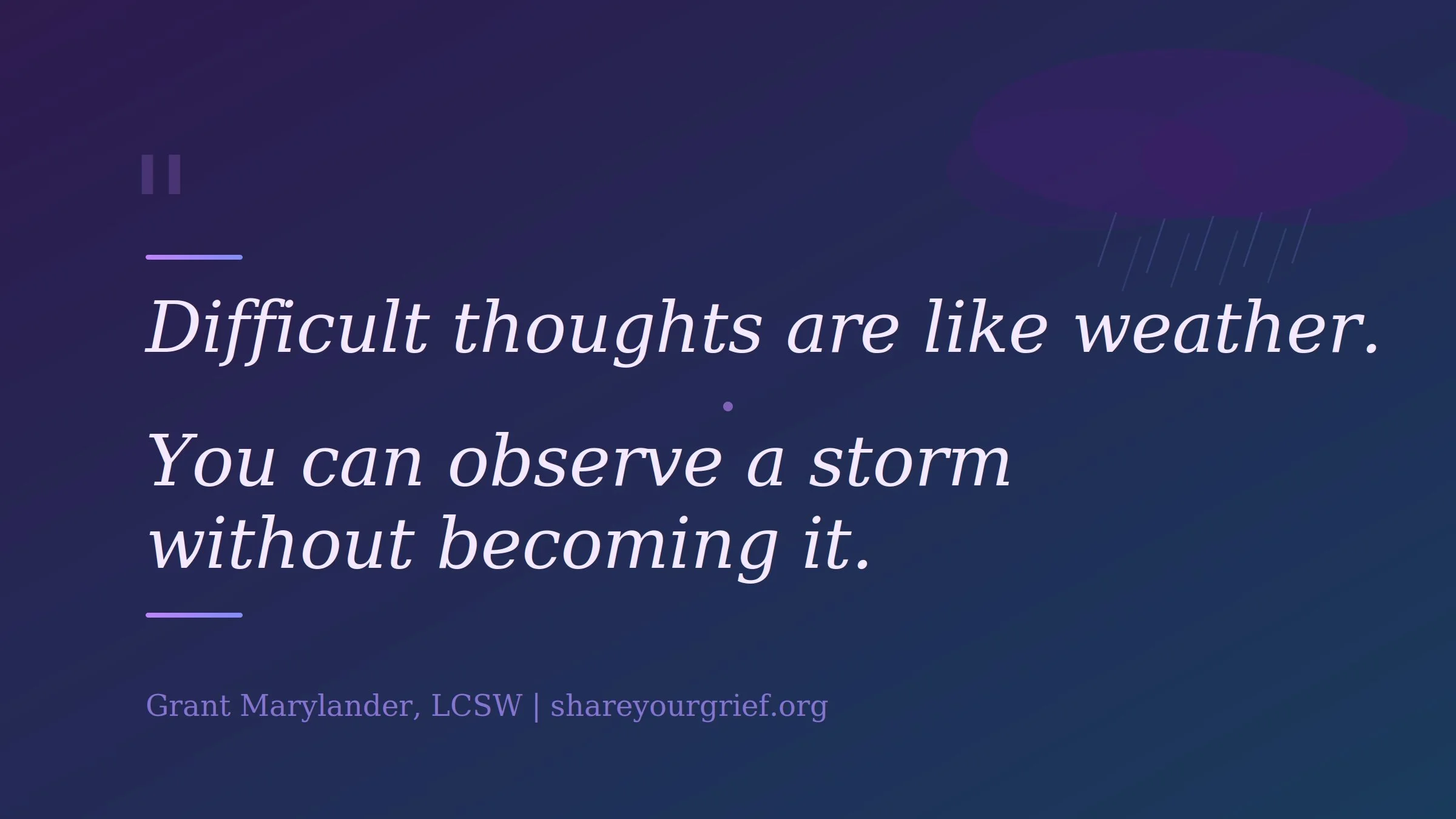
Some people find it helpful to imagine difficult thoughts as weather: conditions that move through, storms you can observe without becoming. The sun does not disappear when it rains. It simply cannot be seen for a while.
What all of these approaches share is an orientation of curiosity rather than combat. You are not trying to defeat the thought or wait until it falls quiet. You are learning to see it clearly, feel the discomfort it brings, and choose your direction anyway. In ACT, that direction is always guided by the same question: what matters to you, and are you moving toward it?
The Shore Is Still There
Anxiety and grief share something important: they both whisper that the shore is not for you, that you are not ready, that it would be safer to wait just a little longer. And the longer we wait, the more persuasive that whisper becomes.
The monsters will come up from below deck when you turn toward the life you want. That is simply what they do. The goal is not to silence them first. The goal is to recognize that their noise is not the same as danger, that they are not steering the boat, and that the shore is still there, whether the monsters are quiet or not.
You do not have to feel ready to sail. You just have to keep your hands on the wheel.
If the thoughts and fears are making it hard to move, hard to function, or hard to imagine what forward could look like, you do not have to find your way through alone. I offer a free 15-minute consultation at shareyourgrief.org. No commitment, no pressure. Just a conversation.
