Why Grief Makes People Disappear
There is a particular kind of loneliness that shows up not in the funeral home but months later when the calls stop coming and the friend who promised to always be there has quietly gone quiet. Most people who experience this assume something is wrong with how they’re grieving. Often the truth is stranger and less personal than that.
In 1973, the cultural anthropologist Ernest Becker published The Denial of Death, arguing that much of human behavior is organized around managing one fact most of us spend our lives trying not to look at directly: we are going to die and we know it. In the mid-1980s, the social psychologists Sheldon Solomon, Jeff Greenberg, and Tom Pyszczynski built Becker's idea into something researchers could actually test. They called it Terror Management Theory and it may be one of the most useful frameworks I know for understanding why grieving people so often find themselves left by the very people who claimed they would always be there.
What the Research Shows
Studies in this area consistently find something unsettling: when people are made aware of their own mortality, even briefly and outside conscious awareness, their behavior shifts in predictable ways. They cling harder to familiar beliefs. They favor people who resemble them and quietly distance themselves from people who don't. None of this is a conscious decision. It happens beneath the level most of us would ever notice in ourselves.
Researchers call the triggering moment mortality salience and one of the most consistent findings is that almost anything can produce it. Completing a will. Walking past a funeral home. And, reliably, encountering someone who is visibly bereaved.
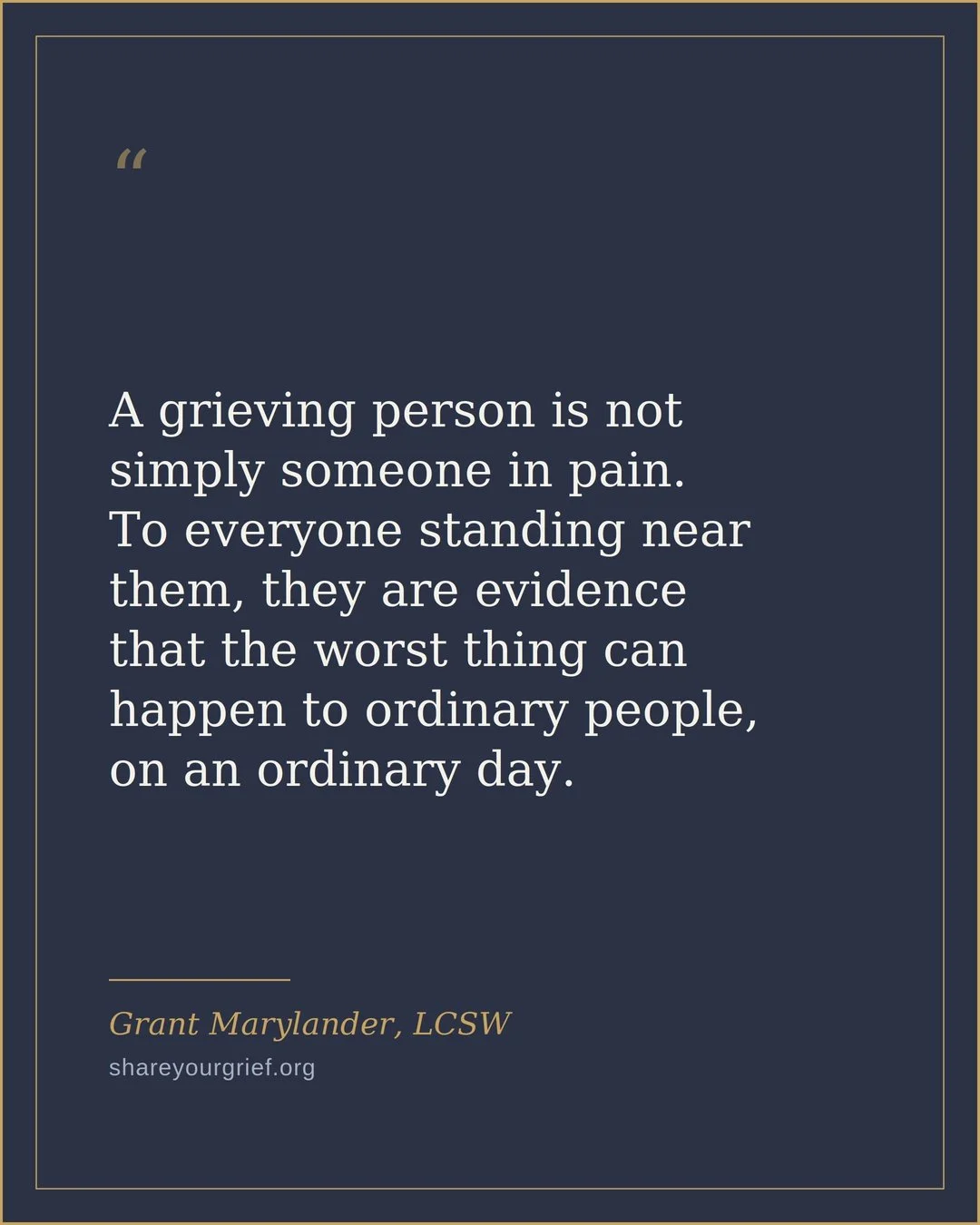
A grieving person is not simply someone in pain. To the nervous system of everyone standing near them, a grieving person is evidence of mortality: living proof that the worst thing can happen to ordinary people, in ordinary ways, on an ordinary Tuesday. That evidence is hard to sit with for very long so people often don't. They look away. They find a reason to be elsewhere. The relationship goes quiet, not out of malice, but because staying close to that evidence is uncomfortable in a way most people don't have language for.
Why This Isn't a Justification
I want to be clear that none of this excuse the harm caused by disappearing on someone in grief. Understanding a behavior is not the same as forgiving its impact. If you have been the person left standing alone while your community found reasons to be elsewhere, the explanation for why it happened doesn't undo the loneliness it created. You are allowed to need people who then failed to show up.
What understanding the mechanism does offer is something different. It can take the sting out of a question so many grieving people quietly carry, some version of what is wrong with me or my grief? In most cases, the honest answer is nothing. Your grief simply asked something of the people around you that their own nervous systems weren't equipped to give without a fight.
Why Some Losses Trigger It Harder
This effect isn't uniform. Losses that feel structurally close to a person's own life tend to trigger more avoidance than losses that feel distant. A peer's spouse dying suddenly is harder for others to sit with than a stranger's death on the news because the similarity, same age, same kind of marriage, same kind of ordinary day, makes the reminder of one's own mortality much harder to file away as something that happens to other kinds of people.
What This Means for You
If you're the one grieving, this isn't a reason to excuse anyone's absence, but it may be a reason to stop searching your own behavior for the imagined flaw that drove people away. And if you're the one standing at the edge of someone else's loss, feeling the pull to busy yourself elsewhere, it may be worth naming that pull for what it is: not a judgment about the person grieving, but a reflex in you. This pattern shows up with particular force in professional settings, where grief carries its own set of unwritten workplace rules. Naming it is often enough to override it. Sometimes the most important thing you can offer a grieving person is simply staying even when every instinct is telling you to look away.
If what you've read here resonates, you don't have to keep navigating this alone. I offer a free 15-minute consultation so we can talk about what you're carrying and whether grief therapy might help. There's no pressure and no commitment, just a conversation. Schedule here.