Why Success Doesn't Fix the Feeling That You're Not Enough
You made partner. You met your deliverables. You got the promotion you'd been quietly working toward for three years. And somewhere in the celebration, maybe that same night, maybe a few weeks later, a familiar voice showed up anyway: okay, but what's next.
If you've lived this, you already know the strange part isn't the ambition. It's that the feeling of not being enough doesn't seem to care what you accomplish. It just moves.
This is one of the patterns I see often in my practice, particularly with clients who are, by any outside measure, doing extremely well. They are not confused about their success. They can name it. What they cannot do is feel it land anywhere that matters.
The Standard That Was Never About the Standard
Psychologists Paul Hewitt and Gordon Flett spent decades studying perfectionism as something more textured than "wanting to do a good job". Their research identified a specific form they call socially prescribed perfectionism: the belief, often held below conscious awareness, that other people demand your perfection, and that being accepted at all depends on delivering it. This is different from simply having high personal standards. It is the sense that the bar was never yours to set, and that falling short of it risks something more than disappointment. It risks exposure.
This distinction matters clinically because it explains something that otherwise looks contradictory: why an achievement can be real, verifiable, and witnessed by other people, and still not touch the underlying fear. If the standard was never really about the work, meeting it was never going to resolve the feeling. The promotion answers a question nobody was actually asking.
Why the Finish Line Keeps Moving
There is a related concept from positive psychology called the arrival fallacy, a term coined by researcher Tal Ben-Shahar to describe the expectation that reaching a goal will produce a lasting sense of relief or completion. What tends to happen instead is a brief lift, followed by a return to baseline, followed by the mind reaching for the next target. This isn't a personal flaw. It rests on a well documented pattern called hedonic adaptation, our tendency to settle back toward our emotional baseline after both good events and bad ones.
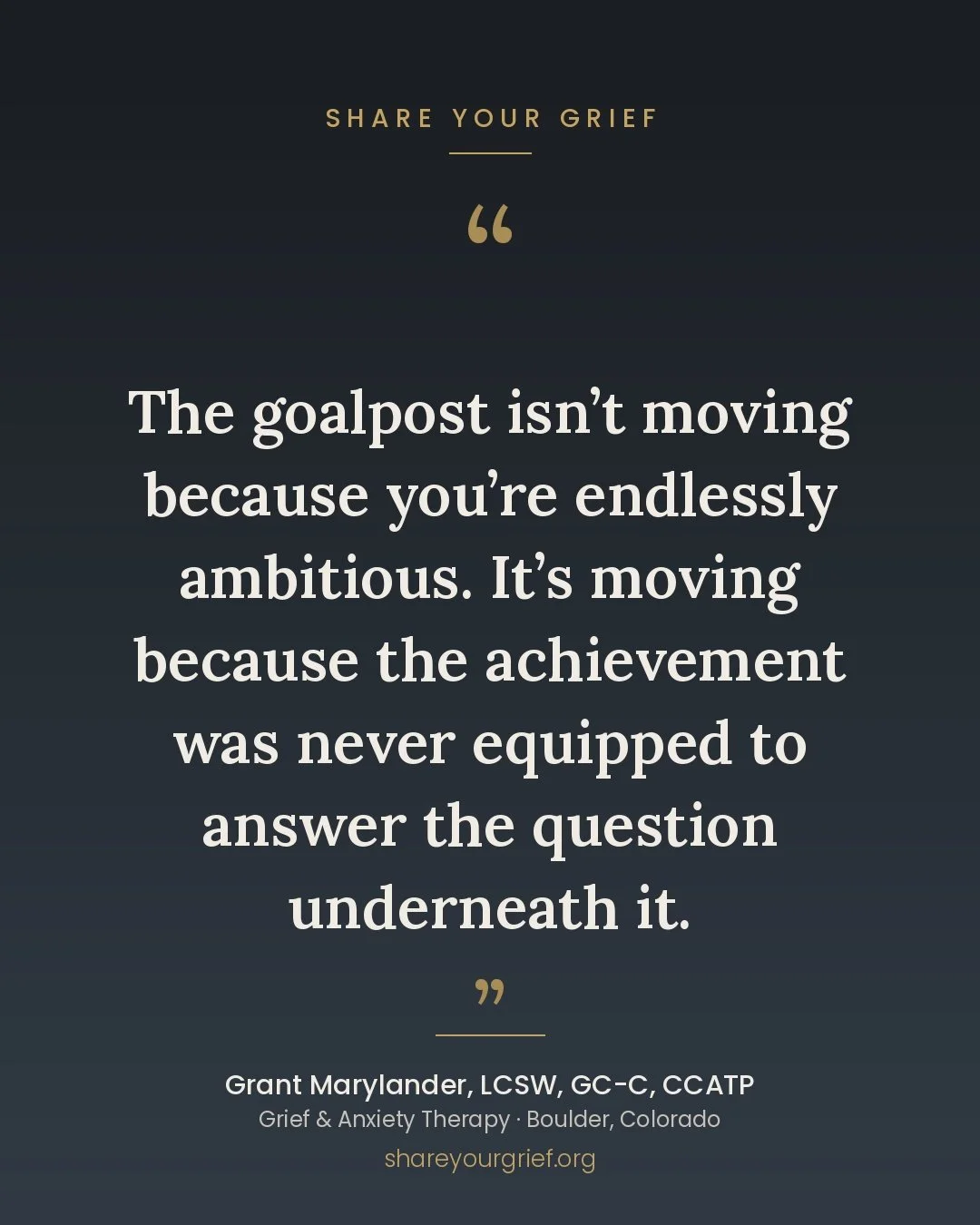
For someone whose sense of enoughness was never tied to the achievement in the first place, this pattern has a particular bite. The goalpost doesn't just move because ambition is natural. It moves because the achievement was never going to answer the actual question. You cannot out-earn, out-produce, or out-perform a fear that was never about output.
This Isn't Just You and It Isn't Just Now
If this pattern feels newly exhausting, that may not be a coincidence. A large scale meta-analysis by Thomas Curran and Andrew Hill, published in Psychological Bulletin in 2019, tracked nearly 42,000 college students across the US, Canada, and the UK between 1989 and 2016 and found that perfectionism, across every dimension they measured, including the socially prescribed kind, rose significantly over that period. Whatever is happening to people who carry this pattern, it is not a private failure of resilience. It is a documented generational shift and you are living inside it along with a great many other capable people who also feel like they are the only ones not keeping up.
What This Can Look Like
The achievement doesn't stick. You can recount your accomplishments accurately and still feel nothing when you do it, as though you're reading someone else's resume.
Rest feels like falling behind. Stopping doesn't feel like rest. It feels like the moment someone might notice you're not actually keeping pace.
Praise gets redirected or dismissed. A genuine compliment gets met internally with a "they don't see the whole picture" rather than landing as true.
The next goal is already visible before the current one is finished. There is rarely a moment of arrival, only a moment of recalibration.
What Tends to Help
Name the mechanism along with the feeling. Recognizing that you are dealing with socially prescribed perfectionism, a specific and well studied pattern, rather than a personal defect, tends to loosen its grip somewhat on its own. It becomes something you are carrying rather than something you are.
Separate the standard from its source. It can help to ask, plainly, whose voice the standard belongs to. Sometimes it traces back to a parent, a mentor, an early professional environment. It is rarely, on close inspection, entirely your own.
Interrupt the redirection. When praise or evidence of success arrives, notice the instinct to explain it away, and try letting it sit unchallenged for even a few seconds longer than feels natural. This is a practiced skill, not a switch.
Get curious about the thoughts driving the pattern rather than arguing with them. This is closely related to the work of creating distance from anxious and critical thoughts rather than trying to out-argue them, a skill that tends to matter more here than sheer willpower.
Look underneath the drive itself. In my experience, this pattern is often connected to a harsh inner critic that developed for a real reason, often early, often as a way to stay safe or stay loved. Understanding where it came from doesn't excuse its cost, but it does make it possible to work with it differently than simply trying to silence it.
A Final Word
If external success has never quite translated into feeling like enough, you are not missing some obvious insight that would fix it, and you are not uniquely broken among otherwise put-together people. You are describing a specific, researched pattern that has gotten measurably more common, not less, in people who look, from the outside, like they have it handled.
The goalpost will keep moving as long as the achievement is being asked to answer a question it was never equipped to answer. That is not a reason to stop striving. It is a reason to get curious about what the striving has actually been in service of.
If this pattern is familiar and you are tired of it, I would be glad to talk. You can read more about therapy for anxiety and perfectionism, or schedule a free 15-minute consultation at shareyourgrief.org. No pressure, no commitment. Just a conversation.