This post is about the lasts: the last conversation, the last meal out, the last text, the last ordinary afternoon with someone who has died. Most writing about grief and time focuses on the firsts: the first birthday, the first holiday, the first anniversary after a loved one died. The lasts get far less attention even though for many people they are where the mind goes first and stays longest.
If you find yourself replaying the last time you spoke, or counting how long it has been since you last saw them, you are not doing anything wrong. Grievers have a name for the counting, “grief math,” and it is one of the most common things people describe to me. Here is why the lasts carry so much weight and what can help when one of them won’t let go.
Firsts arrive from the front. Lasts arrive from behind.
The difference between a first and a last is direction.
You can see a first coming. The first Thanksgiving without your mother is on the calendar weeks ahead. You can dread it, plan around it, and decide whether to set her place or skip the dinner altogether. (I wrote more about that in Grief and Holidays.) It is painful, but you can see it.
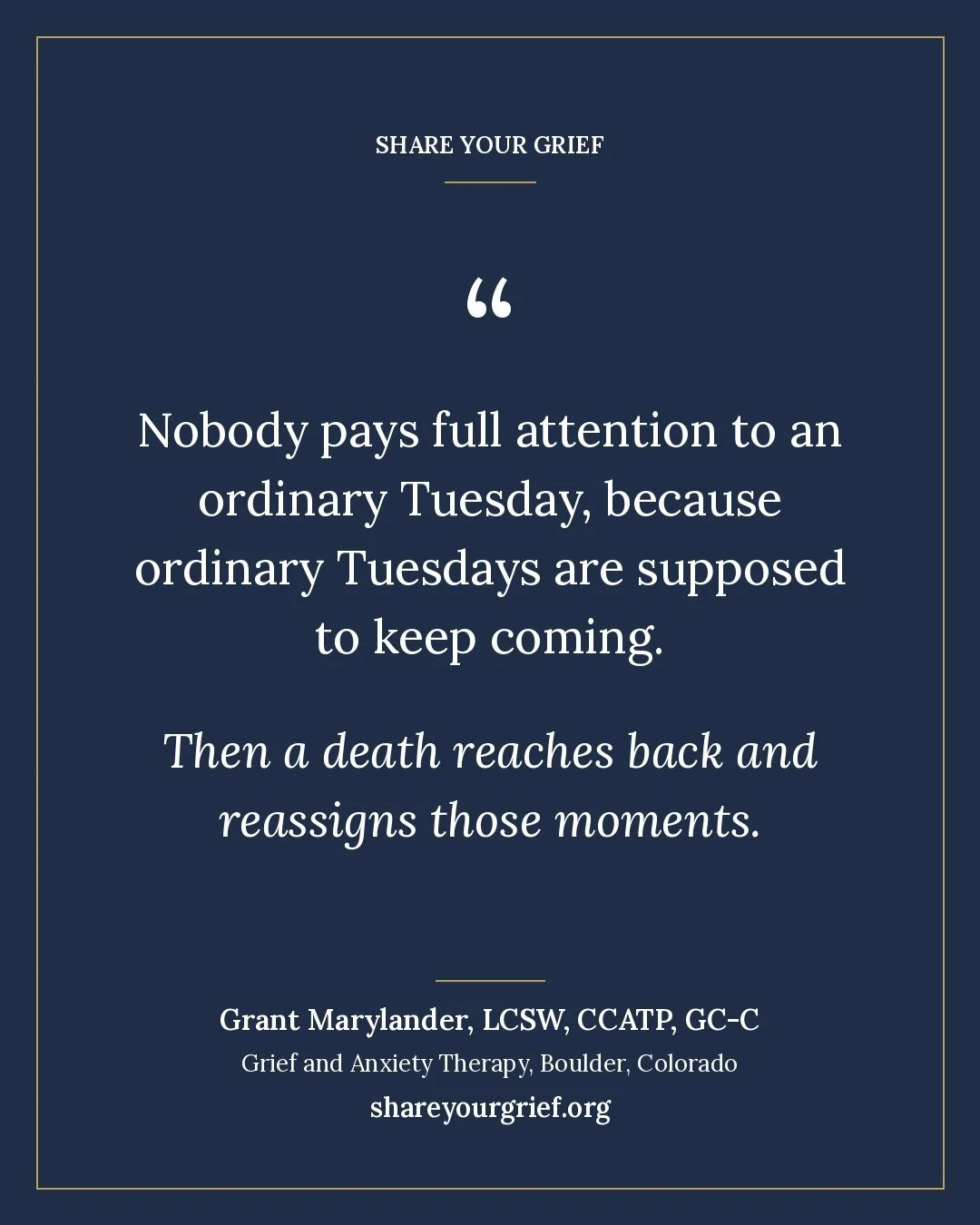
A last is different. It only becomes a last after the fact. When you had dinner at that Italian place in October, it was just dinner. When your brother texted about the game, it was just a text. Nobody pays full attention to an ordinary Tuesday, because ordinary Tuesdays are supposed to keep coming. Then a death reaches back and reassigns those moments. The dinner becomes the last dinner, and the text becomes the last text. You are left holding a moment you never knew you were supposed to remember.
That is why the lasts so often bring a second feeling on top of the grief, something like being caught off guard by your own life. You were there, but you weren’t watching. Of course you weren’t. No one does.
When the last conversation was ordinary, or went badly
This is where the lasts can be distressing.
Sometimes the last exchange was simply mundane: a question about picking up milk, a reminder about a dentist appointment. People may feel almost embarrassed by it, as if the final words should have been worthier of the relationship.
Sometimes it was worse: a short temper on a phone call, an argument that was supposed to get settled the next weekend, a visit you cut short because you were tired. When the last moment was a sharp one, the mind can treat it as a verdict on everything that came before.
It isn’t a verdict. It is one point on a very long line. A relationship lived over years is made of thousands of conversations, most of them unremarkable. That accumulated weight, not the final entry, tells you what you meant to each other. If guilt about the last exchange has settled in, my post on using self-compassion when experiencing shame and guilt goes deeper into what helps.
When you knew it might be the last
There is one setting where people sometimes do see a last coming: a terminal illness, a hospice stay, the long goodbye of dementia. You might assume that knowing would make it easier. In my years in palliative care, I rarely saw it work that way. Families who knew the time was short still described the last conversation as not quite what they had hoped for. Someone was asleep, or in pain, or the right words didn’t come. Or they came and felt too small.
I find this oddly reassuring to share. If even people who were given warning rarely feel they got the last moment right, then “if only I’d known” may not be the regret it feels like. Knowing doesn’t guarantee a better ending. What it often brings instead is the exhaustion I wrote about in Understanding Anticipatory Grief.
The other kind of counting
Alongside the lasts, many grievers keep a running tally of time: forty-one days since the funeral, seven months since you last heard her voice. Some of the counting looks ahead to crossover points that land hard when they arrive, like the day your spouse or partner has been gone longer than you were together, or the birthday when you become older than your father ever got to be.
In Worden’s framework, the first task of mourning is to accept the reality of the loss. I think much of this counting is the mind doing exactly that, one measurable distance at a time. The numbers make real something that still feels impossible. That is not morbid. It is the work.
One thing that helps: notice the story
Your mind is a problem solver. Often this can be helpful: it plans, anticipates and fixes things. But after a death, it can latch onto a problem it has no way to solve. Replaying the last conversation is often the mind trying to go back and get it right, over and over, as if one more pass might change how it ended. It can’t, so the mind keeps trying.
In Acceptance and Commitment Therapy (ACT), one of the most useful responses to this is called defusion. Instead of arguing with a thought or trying to push it away, you step back far enough to see it as a thought: something your mind is producing, not a fact about you or your relationship.
If you notice you keep returning to one of the lasts, try this:
Notice that it’s happening. The replay often runs on its own, so catching it is the first step: “My mind is back at that phone call.”
Name the story. Give it a short, plain title: “Oh, here is the ‘I should have been kinder’ story.” It might be the “I should have paid more attention” story, or the “I should have been more patient” story. Most of us have one or two that come back again and again. Once a story has a name, you can recognize it when it shows up, the way you’d recognize a familiar song on the radio.
Add a little distance. Try putting it as “I’m having the thought that I should have been kinder.” The words are nearly the same, but now you are the one noticing the thought rather than the one caught inside it.
Make room for the feeling. The story usually brings company: guilt, sadness, an ache in the chest or throat. You don’t have to fix it. See whether you can let it be there, notice where you feel it in your body, and breathe around it.
Remember what the story leaves out. A story about the last conversation is not the sum of your relationship. It covers a few minutes out of years. Your mind is handing you a single scene and calling it the whole film.
Ask what the story points to. Regret usually points toward something you care about. “I should have been kinder” tells you that being kind to this person mattered to you. That isn’t evidence against you. It’s evidence of what the relationship meant.
None of this is meant to make the thought go away. It will probably come back because our mind still thinks it’s a problem to solve. The aim is to hold it a little more loosely so it stops standing in for everything else. Our stories are not facts, even the ones that feel most true.
When the counting takes over
For most people, the counting and the replaying are a normal part of grief, and they soften over time without anyone forcing them to. It may be worth talking with someone if, many months on, the last moment still crowds out almost everything else. That could mean you can’t think of the person without landing on that final scene, or the counting has become the main way you spend your days. Sometimes this points to prolonged grief, which is something a grief therapist can help with.
The relationship is not its last sentence
Worden’s fourth task is to find an enduring connection with the person who died while embarking on a new life. Part of that, I think, is letting the relationship be the whole of what it was. The last dinner, the last text, and the last visit matter, and you will likely remember them for a long time. But they were never meant to be the summary. The summary is everything else. (For more on carrying a loss without needing it to end, see What Is Grief Integration?)
If a last moment is weighing on you, or the counting has started to feel like the main way you are carrying this loss, I offer a free 15-minute consultation at shareyourgrief.org. We can talk about what you’re carrying and whether working together might help. You can also learn more about my approach to grief counseling in Boulder.