Litsa Williams of What’s Your Grief wrote a piece called Your Pain Is Not Your Connection that I keep recommending to clients, and I want to expand on it here. Her central idea is that pain connects us to a person’s absence, but it is not what connects us to who they were. She also points out that when pain takes up less room, our other connections have space to strengthen and deepen.
What prompted me to write more is something I hear in my practice again and again. A client tells me, often with real distress, that the tears have mostly stopped, or that they got through a whole day without thinking about the person who died. They feel guilty and some wonder whether they are forgetting their loved on. This post is for them. I want to set Williams’s idea inside the clinical frameworks that explain why those days are not a betrayal.
Why pain starts to feel like proof
In early grief, pain is loud and constant and for many people it is the one thing that still feels tied to the person they lost. So when it begins to ease, the mind sounds an alarm. It worries that if the pain is fading, the person must be fading too, and it produces guilt to keep you vigilant.
That is a protective instinct. It comes from wanting to keep them close. But it is a story, not a fact. The fact, as Williams reminds us, is that your pain is not your connection.
What Worden’s tasks say about pain and remembering
J. William Worden describes four tasks of mourning: accepting the reality of the loss, processing the pain of grief, adjusting to a world without the person, and, in the fifth edition of his handbook (2018), finding a way to remember the person who died while embarking on the rest of your life’s journey.
Look at where pain and remembering sit in that list. Pain belongs to the second task. Remembering belongs to the fourth. They are different work, and the fourth does not ask you to stay in pain in order to stay connected. Worden himself treats a change in pain as a sign of adaptation: the sadness remains, but it becomes a different kind, one that, in his words, “lacks the wrenching quality it previously had”.
He also shares what one teenager wrote to her mother from college, two years after her father died: “There are other people to be loved, and it doesn’t mean that I love Dad any less”. That sentence is the whole task in miniature, and it applies to a quiet afternoon as much as to a new relationship.
These are tasks, not stages. People move among them over years rather than completing one and leaving it behind.
What the work on prolonged grief adds
Katherine Shear and her colleagues at Columbia have spent decades studying people whose grief stays intensely painful and keeps them from living. Their work helped bring prolonged grief disorder into the DSM-5-TR as a diagnosis in 2022. Her framework starts from the observation that most people adapt on their own, with acute grief gradually becoming integrated into life. As her Columbia center puts it, grief “finds a place” there.
For people whose grief does not integrate, she developed Prolonged Grief Disorder Therapy, a 16-session treatment. What I find most telling is its goal. The treatment does not aim to make grief disappear or to fade the person from view. It aims to help people reengage with a life that matters to them, including reflecting on their own aspirations and future, while the grief remains.
That is the same movement Worden describes. The work is not to feel less. It is to live a meaningful life with the grief in it.
The jar and the stone
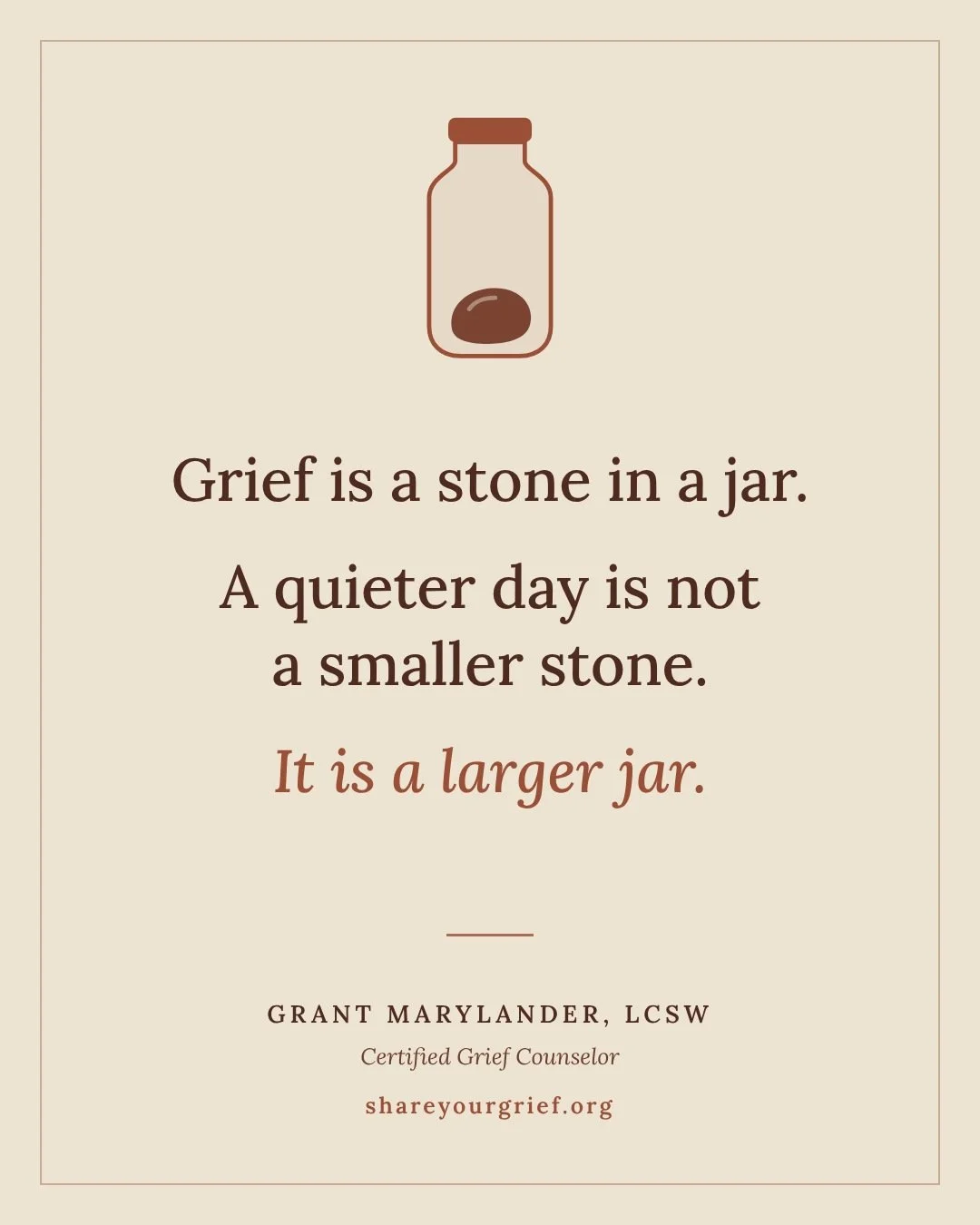
I picture grief as a stone in a jar. The idea behind the image comes from Lois Tonkin’s “growing around grief” (1996): grief does not shrink, but life grows around it. In the early months the stone fills the jar. Over time it stays the same size, but the jar gets larger as you add people, work, routines, and moments that make your life meaningful.
A day with fewer tears is a day the jar held more, not a day the stone got smaller or went missing. The story the guilt tells assumes the only way to honor the stone is to let it fill the whole jar. But the stone is still there and it does not need to take up all the room to be real.
The connections you choose
Pain happens to you. Connection is something you can also do on purpose, and none of it depends on how much you hurt that day. Telling a story about them to someone who never met them. Making their recipe. Making a decision the way they taught you to make it. Visiting a place that mattered to them. Saying their name out loud.
None of these require tears and all of them are yours to choose. So when the guilt arrives on a quieter day, you can notice it for what it is: a protective mind worried about forgetting, telling a story. You do not have to argue with it or obey it. The fact has not changed. Your pain is not your connection.
When to reach out
A quieter grief is not the same as numbness. If you feel nothing and it frightens you, or if your grief has stayed at full intensity and keeps you from your life, that deserves attention. Am I Stuck? When Grief Becomes a Cage can help you tell the difference. For more on why I talk about integration rather than closure, see What Is Grief Integration? and The Myth of Closure. If the breaks you take from pain feel like guilt, Dosing Your Grief may help.
You do not have to work out what a quieter day means by yourself. If you would like to talk it through, I offer a free 15-minute consultation at shareyourgrief.org. There is no obligation, just a conversation to see whether working together feels right.
Grant Marylander, LCSW, Certified Grief Counselor, is a grief and anxiety therapist in Boulder, Colorado.