Caregiver Grief After Death: Why Relief and Guilt Often Arrive Together
The hospital bed has been picked up. The pill organizer is empty. And yet some part of you is still on duty. You wake at the old medication time. You listen for a sound from the other room. Your body braces when the phone rings. Caregiving ends on a particular day, but the vigilance it built does not.
If you spent a long stretch caring for someone who has died, you may be carrying several things at once: grief, relief, guilt, a strange emptiness, and a body that will not stand down. In my experience, most caregivers stay hypervigilant after the death, and it can take months, sometimes longer, to ease. Nothing is wrong with you. And if part of you also feels relieved, you did not love them less. This post is about all of it.
Why relief is so common
Caring for someone at the end of life asks for a kind of vigilance most people have never practiced. Listening for the cough at night. Tracking medications. Making decisions no one trained you to make, often while exhausted. I have written about the toll of dementia caregiving while someone is still here. When it ends, your mind may know the work is over long before your body does. And if you have been grieving for a long time already, that has a name: anticipatory grief.
The research reflects this. In a study of 217 family caregivers of people with dementia, depressive symptoms fell significantly within three months of the death, and 72 percent said the death was a relief to them. More than 90 percent believed it was a relief to the person who died (Schulz et al., 2003).
Relief usually has two parts: relief that their suffering is over, and relief that yours is. Most people can forgive themselves for the first kind. The second kind is the one that gets whispered about, if it is mentioned at all. Both are human. Most of this research follows caregivers of people with dementia, so I would be careful about assuming the numbers apply to every illness. The pattern, though, is one I hear after long cancer, heart failure, and frailty care too.
Relief does not mean you grieve less
You might expect that feeling relieved would signal a colder loss or an easier one. The evidence points the other way. In a later study of dementia caregivers, those who felt more relieved after the death reported fewer symptoms of complicated grief. Relief was more likely when caregivers felt prepared for the death and believed it was a relief to the person who died (Stahl and Schulz, 2019). This is an association, not proof of cause, but it fits what I see: relief is often what it feels like when someone who gave a great deal is finally allowed to set it down.
Why guilt follows
Guilt tends to come from three directions.
The relief itself. Feeling glad that it is over can feel like betrayal, as though the feeling proves you wanted them gone. It does not. You wanted their suffering to end, and you wanted your own life back. Both wishes can be true at once, and having the second one does not make the first any less loving.
The decisions. The decision to start hospice, or the days you hesitated before making that call. The medication you questioned, the hospital transfer, the afternoon you lost your patience. For some people, not being in the room at the moment of death. These decisions replay because the mind is searching for a version where it ends differently, and that search runs on hindsight. Hindsight holds information you did not have then.
The standard. Caregivers often measure themselves against someone who never snapped, never needed a break, never got it wrong. If you hold yourself to an exacting standard in the rest of your life, caregiving gave that standard an enormous amount to work with. No real caregiver meets it. That is a flaw in the standard, not in you.
It also helps to separate guilt from shame. Guilt says I did something wrong, and it usually points at specific moments. Shame says I am wrong, and it points at you. If your thoughts have moved from “I wish I had handled that day differently” to “I was a bad spouse, or a bad child,” it is worth slowing down. I wrote more about shame and guilt and why reasoning with yourself rarely shifts them.
When caring was the meaning
Not everyone feels relief, and one research finding surprises people. In a study of dementia caregivers, those who reported more positive aspects of caregiving before the death, such as meaning, closeness, and purpose, had more grief and depression afterward, even after accounting for how burdensome the caregiving had been (Boerner et al., 2004). One explanation researchers have offered is that these caregivers lost two things at once: the person and a meaningful role.
If caregiving organized your days, its absence can feel like a floor removed. The calls from nurses, pharmacists, and clinic staff often stop. You may feel relieved and bereft in the same hour. That is not confusion. It is two true things, and it is one of the secondary losses that follow a death.
What tends to help
Name each feeling as its own thing. Relief, grief, guilt, and emptiness are not one feeling. Try saying them as separate sentences: “I am relieved. I miss them. I feel guilty about being relieved. I do not know what to do with my days.” Accepting these feelings rather than trying to push them away actually helps us navigate all of the emotions we can experience without becoming overwhelmed by them.
Practice self-compassion. Speak to yourself the way you would speak to a friend who had just spent a year caring for someone she loved. Kristin Neff describes self-compassion as three parts: kindness toward yourself instead of harsh judgment, remembering that struggle is part of being human, and noticing your pain without pushing it away or being swept away by it. When guilt gets loud, try a few plain sentences, aloud or on paper: “This is painful. Other caregivers have felt this too. I did the best I could with what I knew.” They may feel awkward at first. You are not arguing yourself out of the feeling. You are changing the tone you bring to it.
Return to the whole person, on purpose. Years of illness can crowd out the person who came before it. Choose something deliberate: pull out three photographs from before the diagnosis, tell one story at dinner that has nothing to do with the illness, or write them a letter about something ordinary. This is one way of keeping the bond, and it is yours to choose.
Let your body come down slowly. As I said at the start, vigilance does not switch off on the day of the death. It tends to wind down on its own schedule, often over months, and sometimes longer. Waking at the old hour or startling at a ringing phone is not a sign you are doing it wrong. It is part of why grief is so physically exhausting. Rest is allowed. Doing very little for a while is allowed.
Put one thing of your own back. J. William Worden describes one of the tasks of mourning as adjusting to a world without the person. For a caregiver, that includes a day with a different shape. You do not need a plan for the year. Start with something you set aside: a walk, a call to a friend, a book you never finished.
Tell one person the unsayable part. Relief is a grief people rarely give permission for, which is part of why it can feel so lonely. It is a form of disenfranchised grief. Find one person who will not flinch: a friend, a support group, a therapist. Saying it out loud to someone who stays tends to loosen its hold.
When to reach out for more support
Some guilt and heaviness after caregiving are expected. If you are stuck in a loop of self-blame, if intense longing or numbness still fill most of your days well past the first year, or if you cannot picture a life beyond the caregiving, it is worth talking to someone. If you are having thoughts of harming yourself, call or text 988.
A Final Word
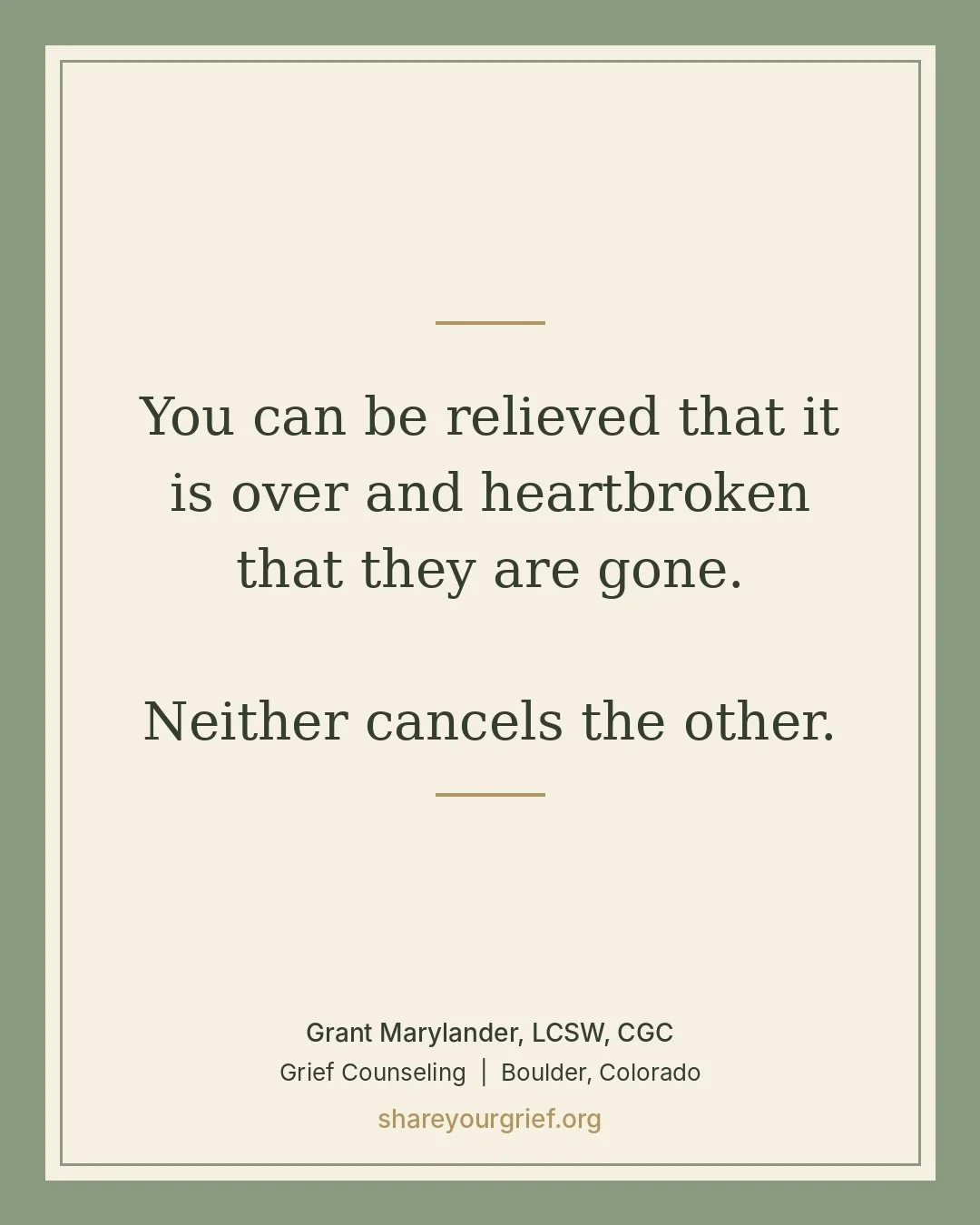
You can be relieved that it is over and heartbroken that they are gone. You can be proud of the care you gave and wish you had done some of it differently. None of these cancels the others. That is what integration looks like: not a verdict on whether you did it right, but a life that grows large enough to hold the love, the exhaustion, the relief, and the loss.
If you spent months or years caring for someone and the aftermath is harder to carry than you expected, I would be glad to talk. You can read more about grief counseling in Boulder or schedule a free 15-minute consultation at shareyourgrief.org. No pressure, no commitment, just a conversation.