Pets and Grief
The loss of a pet can produce grief that mirrors the loss of a human loved one and the world rarely treats it that way. The brain fog, the sleep trouble, the void where the morning routine used to be: all of it is real, and all of it deserves to be mourned.
The bond we share with our pets is one of unconditional love, comfort, and routine. They are family members, confidantes, and constant presences in our lives. When that bond is suddenly broken, the emotional fallout can be devastating, often mirroring the pain experienced after the loss of a human loved one.
It’s crucial to understand that the grief process for a pet is fundamentally similar to any other loss. You may be experiencing a wide range of emotions, including intense sadness, denial, guilt, and anger. The guilt might stem from second-guessing medical decisions or the circumstances of their death, while anger might be directed toward the world for taking them too soon. These turbulent emotions are a normal and natural part of your grief journey.
It is also important to remember that grief is not just emotional; we experience physical changes and our brain struggles to make sense of a loved one’s absence (for a great exploration of grief and biology, I highly recommend Mary-Frances O’Connor’s books, The Grieving Brain and The Grieving Body). Many of my clients report brain fog, challenges with sleep, and fatigue.
The absence of our routines—the morning greeting, the daily walk, the evening snuggle—creates a vast, painful void. Acknowledging your intense, multifaceted grief is one of the important tasks of mourning. Give yourself permission to mourn fully and openly, just as you would for any significant loss. Be kind to yourself, seek support, and honor the deep love you shared.

The Toll of Dementia Caregiving
Sixteen million Americans provide unpaid dementia care and they do it longer and at higher cost to their own health than other caregivers. Respite genuinely helps, even a few hours a week, and there is a specific way to ask for it that works better.
The majority (80%) of people with dementia are receiving care in their homes. To put this in perspective, 16 million Americans provide more than 17 billion hours of unpaid care for their loved ones. It is notable that dementia caregivers provide care for a longer duration than caregivers of people with other types of conditions.
Caregiving takes its toll and this is especially true for dementia caregivers. Dementia caregivers report higher levels of stress, more depression and anxiety symptoms, and lower levels of subjective well-being, self-efficacy, and anxiety. Further, caregivers experience worse physical health outcomes, including higher levels of stress hormones, compromised immune response, antibodies, greater medication use, and greater cognitive decline.
So what can we do?
There are protective factors for stress and depression: Larger social networks, frequent social contact, and the ability to arrange for assistance from friends are moderators of depressive symptoms and caregiver burden. Respite care is especially important. Research shows that even a few hours of respite a week can improve a caregiver’s well-being. Respite care can take the form of different types of services in the home, adult day care, or even short-term nursing home care so caregivers have a break or even go on vacation.
It is critical that caregivers make their needs known. For example, identify a caregiving task or a block of time that you would like help with. Perhaps there’s a book club meeting you’d like to attend or some time alone to read a book. Be ready when someone says, “What can I do to help?” with a specific time or task, such as, “It would be really helpful for me if you could stay with mom on Tuesday night so I can go to my book club for 2 hours.”
Be understanding if you are turned down. The person may not be able to help with that specific request, but they may be able to help another time. Don’t be afraid to ask again. If you have trouble asking for help face to face, try writing an e-mail to your friends and family members about your needs. Set up a shared online calendar or scheduling tool where people can sign up to provide you with regular respite.
Need more suggestions or resources? Boulder County offers support for caregivers through its AAA Caregiver Initiative. Alzheimers.gov provides helpful tips for dementia caregivers.

Can an Adult be an Orphan?
The death of an elderly parent is often treated as just part of life, which leaves adult children grieving without acknowledgment. One client put it precisely: when one parent dies it is a semicolon, when the second dies it is a period.
In the often cringe-worthy but hilarious show, Curb Your Enthusiasm, the lead character Larry David challenges his friend Marty Funkhouser’s statement that, with the death of his mother, he is now an orphan. "An orphan? You're a little too old to be an orphan."
I suspect that Larry’s reaction is not uncommon. Indeed, since it is expected that adult children will survive their parents, there is often the belief that when an elderly parent dies, “it’s no big deal - just part of life.” Unfortunately, the failure to recognize the impact of a parent’s death, regardless of the age of the child, can lead to disenfranchised grief, i.e., grief that is not openly acknowledged, socially supported, or publicly mourned.
This is tragic because, regardless of your relationship with your parent, their death can trigger strong emotions: sadness, relief, anger, guilt, regret. Further, there is a finality when both parents die that can shake our world. One client phrased it especially well: “When one parent dies, it’s a semi-colon. When the second parent dies, it is a period.”
The death of our parents can bring families closer to together and move them farther apart. Many times our parents are the “glue” that keeps a family together and, with their death, old wounds become raw again.
We also can experience a loss of identity and find new roles emerge. We may feel that we are no longer someone’s child. We may grieve the fact that we will have unanswered questions about our parents’ lives and history, or feel unable to resolve longstanding challenges.
As with all grief journeys, it is important to remember you have the right to express and experience your grief in your own way, including the right to express and explore your feelings. It may be helpful to note when you engage in rumination about what we “should have” done differently and accept that we did our best in the moment. And always remember there is no expiration date on our grief.

Children and Funerals
Parents often worry that a funeral will be too much for a child. What frequently happens instead is that children who are excluded feel confused and resentful. There is no universal rule, but there is a good way to make the decision together.
I am often asked by parents whether their children should attend a loved one’s funeral. Parents may be concerned the child will become overwhelmed or “too sad” if they attend. And, of course, there is the societal discomfort with grief and mourning generally that can color our views. It is important to note that children often feel excluded when they are not permitted to attend a funeral and may feel confused or resentful at the exclusion. Further, funerals serve an important role in the grieving process and allowing a child to attend may support their healthy grieving journey.
Having said all of this, there is no hard and fast rule – child participation should be guided by your child’s personal choices and your understanding of their needs, coping skills, and maturity. When deciding whether a child should attend, start with a conversation with your child. Share some basic details about what they may expect at the funeral (e.g., open casket, rituals, graveside internment). Discuss how people may react, including you and other loved ones. It is important to help your child understand that if someone is sad, quiet, or crying, they are showing their sadness and they are still okay. If it is appropriate for their age and maturity, allow your child to choose what parts they want to attend or skip. And, as always, avoid euphemisms (e.g., “passed away,” “resting in peace”) when discussing death – euphemisms tend to be confusing for children especially for those who are still grappling with ideas surrounding object permanence and the finality of death.
Here are two links for more thorough discussions regarding children and funerals that you may find helpful:
https://www.psychologytoday.com/us/blog/good-mourning/201805/should-children-attend-funerals
https://riseandshine.childrensnational.org/preparing-your-child-for-a-funeral/
.
The Challenge of the Uncomfortable Friend/Family Member
We live in a death averse society and one tragic consequence is that the people you counted on may vanish when you need them most. Since they are unlikely to figure it out on their own, here are four specific things you can tell them.
We live in a death adverse society. Most people die in hospitals or facilities away from the home and the community. We treat death as a taboo subject preferring silence or euphemisms such as “passed away” to avoid the stark language of “death” and “dying.” Often people who are grieving feel pressure to “move on” or “get over” their grief.
One of the tragic consequences is that you may feel isolated following the death of a loved one because your friends and family seem to disappear. There are several reasons for this. They may be uncomfortable with their or your emotions. They may find it difficult to be around you especially when you share emotions such as sadness, anger, and guilt. Often people will avoid the subject of death because they worry about upsetting you. Others feel the need to be a “fixer” and and say things like: “Everything happens for a reason” (they don’t), “try to be positive” (i.e., don’t feel or show emotions that make me feel uncomfortable), “it’s time to move on” (I’m uncomfortable with your grief).
For those of us grieving, it falls to us to educate friends and family members about our grief journey. Some of the things we can do include: (1) Letting people know how they can help (be specific); (2) assuring people that it’s okay to talk about your loss and to ask how you’re feeling (if it is); (3) saying when you want company and when you want to be alone; and (4) telling people know there’s no expiration date on grief.

Grief - When Will I Feel Better?
It is the question I am asked most often as a grief therapist and the honest answer is unsatisfying at first. There are no stages, the process is not linear, and yet people genuinely do feel better over time. Here is what actually changes.
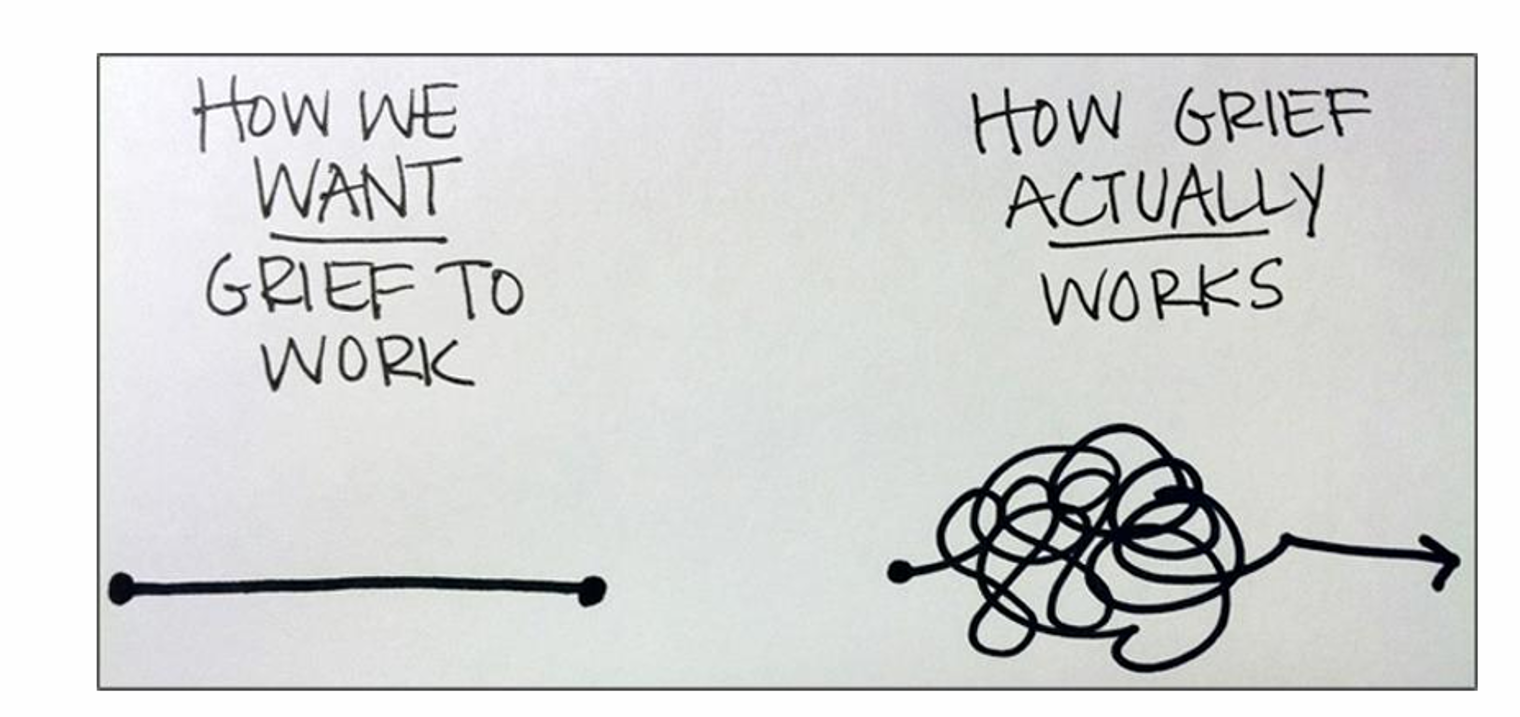
When we’re in the depths of grief, we can feel overwhelmed, unsteady, and rocked by deep emotion. It’s therefore understandable that one of the most common questions I get as a grief therapist is, “when will I feel better?” The answer can be unsatisfying because grief is not linear and there are no stages of grief (contrary to outdated “stages” espoused by Dr. Kubler-Ross). Rather, we each have a unique grief journey and while we ultimately learn to incorporate death and loss into a meaningful life, our grief never ends because our connection with our loved ones never ends. Having said all of this, people will feel “better” over time as they discover a balance between grieving their loss and living a fulfilling life.
The Importance of Continuing Bonds
Staying connected to someone after their death is not denial, and it is not a failure to move forward. Dreams, a felt sense of presence, striking coincidences, and talking to them are among the most natural and healthy parts of mourning.
The Importance of Continuing Bonds
You reach for your phone to text them before you remember. You talk to their photograph while the coffee brews. Something happens at work that only they would have found funny and you tell them about it out loud in the car on the way home.
And then, often, a second thought arrives. Is this normal? Should I still be doing this?
For most of the last century, the answer people absorbed from the culture around them was no. Grief was a process of letting go and someone still talking to a person who died two years ago had gotten stuck somewhere they should have moved past.
That turned out to be wrong and researchers have known it for thirty years. Most people never heard.
Why the Bond Does Not Simply Stop
Start with the biology, because it explains more than the theory does.
Human beings attach. Infants are born dependent on a caregiver for survival, and evolution built a loud alarm system to keep that caregiver close: protest when they leave, distress that does not resolve until they come back. That system does not switch off when we grow up. It stays online, attached now to a spouse, a parent, a child, the handful of people across a lifetime who become what attachment researchers call a secure base.
Which is why grief so often feels less like sadness and more like an emergency. It is protest. It is a nervous system that spent years, sometimes decades, organized around one person's reliable presence, still firing the alarm it evolved to fire, with no return that will ever satisfy it.
So when you catch yourself reaching for the phone, that is not a failure to accept anything. That is the system doing exactly what it was built to do.
Where the Old Idea Came From
The belief that grief means detachment has a specific origin. In 1917, Freud described mourning as the gradual withdrawal of emotional investment from the person who died, so that the energy tied up in that relationship could be freed and placed elsewhere. The goal was a clean severing. Someone still emotionally tied to a person who had died was, in that model, failing at the task.
That idea had an extraordinary reach. It shaped clinical training, popular advice, and the ordinary sense that moving forward requires letting go. It is where "closure" comes from, and why closure is a myth is the same argument from a different direction.
Then in 1996, Dennis Klass, Phyllis Silverman, and Steven Nickman brought together twenty-two researchers who had all noticed the same thing in their own work with bereaved people, from widows to grieving children. The resulting book found what the older model had missed. People who were grieving well did not sever the bond. They kept it, in changed form, indefinitely.
What changes after a death is not whether the relationship exists. It is the shape it takes.
The Things That Happen to You
Some of this arrives on its own, and those are the experiences people are most afraid to mention.
Dreams. These are often vivid in a way ordinary dreams are not. Some people wake comforted, having had a few seconds of the person being alive and ordinary. Others wake devastated by the moment of remembering again. Some are troubled instead by the absence of these dreams, waiting for a visit that never comes and wondering what it says about the relationship. It says nothing. Dream recall varies enormously between people, and it shifts with sleep quality, which grief disrupts badly on its own.
A sense of their presence. The feeling that someone is in the room. A familiar scent with no source. Your name in their voice in the half second before waking.
In 1971, a Welsh physician named Dewi Rees interviewed 227 widows and 66 widowers in his own practice and found that almost half reported experiences of this kind. The most common by far was a felt sense of presence, reported by roughly four in ten. He concluded they were normal and, for most people, helpful. Reviews since have found the same thing consistently.
One number from that study matters more than the prevalence figure. Fewer than three in ten of the people who had these experiences had ever mentioned them to anyone at all. They were afraid of being ridiculed or felt the experience was too private to say out loud.
So this is not rare. It is nearly silent. Which is exactly why each person having it concludes they are the only one.
If you have had one of these and never told a soul, you can put that particular worry down. And if you have never had one, that means nothing about your grief either.
What a Bond Actually Is
Here is the distinction that matters and it is the reason the section above is short.
None of those experiences is a continuing bond. They happen to you. You cannot summon them, you cannot schedule them, and for a great many grieving people they never arrive at all. Something that visits you unbidden cannot be the thing you are asked to build.
A bond is not something that visits. It is something you keep.
That is good news because it means this is not a matter of luck or temperament or whether you are the sort of person who dreams vividly. It is a matter of what you choose to do.
What You Can Actually Do
Talk to them. Out loud in the kitchen, silently in the car. Ask their advice about a decision and notice that you already know what they would say, because you knew how they thought. This is the most common form the bond takes and the one people are quickest to apologize for. There is nothing to apologize for.
Say their name to other people. Keep them in your sentences. Bring them up at dinner. This is the practice most often shut down by everyone around you, who go quiet or change the subject because they are afraid of upsetting you. You are allowed to be the one who brings them up, and doing it once usually gives the people around you permission they did not know they had.
Build a ritual. A candle on a birthday. Their recipe at the holiday. A walk somewhere that was theirs. Rituals work because they give the bond a container: a designated time and shape, rather than a feeling that has to be managed continuously.
Keep the objects, on your own schedule. The watch, the sweater still in the closet, the handwriting on a grocery list. There is no correct timeline for any of this and no one else gets to set one for you.
Carry the values forward. Notice their generosity in how you treat a stranger. Catch yourself saying something they used to say. Make a decision the way they would have made it. This is the most durable form the bond takes, because it lives in who you are becoming rather than in something that can be lost or broken.
Use the practices of your tradition, if you have one. Prayer, a mass said in their name, a belief about where they are now. These frameworks carried continuing bonds for most of human history, long before anyone gave the idea a name.
The Honest Complication
Continuing bonds are not universally protective and a post that told you otherwise would be inaccurate.
Researchers still disagree about which forms help and which ones cost something and I would rather say that plainly than hand you a tidier answer than the evidence supports. Two things do seem to hold. Bonds tend to be harder to carry when the relationship itself was conflicted or dependent while the person was alive. And what matters is less how often you do something than which direction it points.
So the questions worth asking are these. Does this let you return to your life afterward or does it pull you out of it? Does it hold both the love and the death, or does it need the death to stay unreal?
That last one is the distinction that matters most. Avoidance feels like refusing reality, an insistence that nothing has really changed. A continuing bond feels different from the inside. It has already absorbed the fact of the death and found a way to persist anyway.
Technology has sharpened this. Griefbots, trained on a person's messages and voice, can now answer back. I have written about the digital afterlife and where that line falls. An imagined conversation is an ordinary continuing bond. A simulation that responds is a different thing, and it can quietly make the finality harder to absorb.
If your bond feels less like connection and more like a place you cannot leave, that deserves attention rather than judgment. If you are wondering whether you are stuck, the question is worth a real answer rather than an anxious loop.
Carrying Them Forward
What continuing bonds offers is not permission to hold on in defiance of moving forward. It is a more accurate description of what actually happens, and an invitation to do it deliberately rather than by accident.
You do not detach. You find, gradually, that the person you lost has become part of how you see, what you value, and how you move through a day. That is what grief integration actually looks like: not grief ending, but a life growing large enough to hold both the loss and everything still ahead of you.
So talk to them. Say the name at dinner. Keep the sweater. Cook the recipe on the day.
None of that is a failure to move forward. It is the relationship continuing, in the only form still available to it, which is the form you carry.
If you are grieving and finding this harder to navigate alone than you expected, I would be glad to talk. You can read more about working with a grief therapist, or schedule a free 15-minute consultation. No pressure and no commitment, just a conversation.
