Grieving at Work: What to Do When the Bereavement Leave Runs Out
Three days of bereavement leave and then you are expected to be a functioning professional again. The card is on your desk, the condolences have stopped, and nobody asks again while you are still months from the hardest part. Here is what actually helps, including what to say when someone asks.
You went back on a Monday. Someone left a card on your desk. Two people said they were sorry. By ten in the morning you were in a meeting about Q3 targets nodding along and you realized you had not heard a single word anyone said.
This is the part of grief nobody we’re often unprepared for. Not the funeral. Not the first night alone in the house. The Tuesday a week after your loved one died when you are expected to be a functioning professional and you cannot remember your own password.
The Math Does Not Work
Bereavement leave, which on average is between three and five days, was never designed around what loss does to a person. It was designed around a funeral, a logistical event with a start time and an end time that has very little to do with the years of adjustment following it.
One thing worth knowing before you go back: bereavement leave is often not the only time available to you. Many employers permit accrued sick time or personal days to be used for grief, for memorial services, or for the legal and financial work that follows a death. Most people never ask because they assume the three days were the whole allotment. It is worth a direct question to HR before you burn through vacation you may want later, particularly for the first anniversary.
Why Work Is Uniquely Hard
There is a specific reason grief and employment collide so badly and it has nothing to do with how much you like your job.
Grief consumes an enormous amount of cognitive resource. Your brain is running a continuous background process reconciling the deep-seated knowledge that this person belongs here with the new information that they are gone. I have written elsewhere about why grief is so physically exhausting and the short version is that the fatigue is real and physiological.
What that looks like at a desk is specific and worth naming, because most people assume they are failing rather than functioning normally under load.
Tasks that used to take twenty minutes take an hour. Names, dates, and details of meetings you attended last week are simply gone. Small decisions carry the weight of large ones and choosing what to eat for lunch can feel genuinely difficult in a way that is embarrassing to admit. And the waves arrive without scheduling around your calendar. You can be entirely fine at nine and undone by two.
This is not a rare experience. In a survey of nearly 1,500 bereaved Americans conducted by the bereavement benefits company Empathy, 76 percent said their performance or standing at work had been harmed and 43 percent of full-time employees reported regular trouble concentrating.
Work asks for precisely the capacities grief takes first. It asks grieves to work for eight hours, on a schedule, in front of people.
And it asks for something else that grief makes almost impossible: consistency. Work has no category for someone who is competent in the morning and hollowed out by mid-afternoon. So most grieving people do the only available thing, which is to perform a stability they do not have.
The research bears this out. In a 2025 study of bereaved employees, nearly half reported feeling they needed to appear composed and professional, about a third felt they had to actively conceal expressions of grief, and about a third felt pressure to return to normal. That performance is exhausting on top of an exhaustion that was already total. That instinct to conceal isn't unique to bereavement leave. Plenty of grief goes unacknowledged even when no one has taken a single day off, including the grief carried by the people standing just outside the loss itself.
That instinct to conceal isn't unique to bereavement leave. Plenty of grief goes unacknowledged even when no one has taken a single day off, including the grief carried by the people standing just outside the loss itself.
The Card, and Then Nothing
Here is the pattern I hear most often and the research describes it with some precision.
The acknowledgment usually happens. In that same 2025 study, the large majority of bereaved employees reported that coworkers and direct supervisors recognized their loss. Someone signs a card. Someone says they are sorry. That part, most workplaces manage.
What almost never happens is anything after that. In the same study, only about a third of employees reported any check-in from their organization after they returned. Fewer than one in five were given a lighter workload. Fewer than one in ten received help with actual tasks. Recognition from HR or executive leadership was rare.
So the experience is not exactly that nobody says anything. It is that everyone says something once, in week one, and then the subject closes permanently while you are still four months from the worst of it. The card is on your desk. The casseroles have stopped. Nobody asks again.
And people do go quiet in the ordinary social sense too. The colleague who was warm at the funeral is awkward at the coffee machine two weeks later. Conversations reroute when you approach. What is worth understanding is that this is usually not indifference. Researchers looking at why colleagues withdraw find it is more often not knowing how to show care, feeling awkward, assuming the support would be unwanted, or simple discomfort with the emotion in the room.
Workplaces amplify all of this beyond ordinary social avoidance. There is already a professional norm against emotional display, and your grief hands people a socially sanctioned excuse to avoid something they were inclined to avoid anyway. I have written about why grief makes people disappear more generally, and everything in that post applies here with professional cover layered on top.
Understanding the mechanism does not undo the loneliness. You are still the person eating lunch alone while everyone talks around the thing that has reorganized your entire life. But it may spare you the additional work of searching your own behavior for what drove them off. Nothing did.
Work has a way of treating any loss it cannot see, a marriage ending, a job disappearing, a friendship fading, as less real than a death. That's part of a pattern worth naming.
What to Say, and Who to Say It To
You do not owe your workplace the full story and you do not owe everyone the same version. What helps is deciding in advance, because the moment of being asked is not a moment when you will be able to compose an answer.
This is the tiered response applied to a professional setting. Your close colleague may get the truth. The client on the Thursday call gets something brief and closed. Having the sentence ready matters more than which sentence you choose.
A few that my clients have found useful:
"I’m glad to be back, but I’m still navigating a difficult time. If I seem quiet or need to step away, please don’t take it personally."
"I’m struggling with focus right now. Could you send that request in an email so I can keep track of it?"
Find one safe person. This does not appear in the research literature, but it is among the most useful things I recommend in practice. Pick one colleague or manager you trust and tell them plainly: if I am having a hard day, I may need ten minutes in a private room. That one conversation, held once, removes the need to explain yourself every subsequent time. It also means someone in the building knows what is going on with you which matters more on the bad days than you would expect.
Tell people what you want from them because they will not guess. Given that most workplace silence comes from not knowing what to do rather than not caring, you have more influence here than it feels like you do. Something as plain as "you can say his name, it helps" or "I would rather you email me than come to my desk" gives a colleague a script they did not have. This is unfair. You are the one with the least energy and you are doing the work of teaching everyone else how to behave. It is still, in practice, the thing that most often breaks the silence.
Ask for specific accommodations rather than general understanding. "I’m having a hard time" invites sympathy and produces nothing. "I need to move my recurring Monday morning meeting to Wednesday for the next two months" produces a changed calendar. Researchers who interviewed bereaved people about returning to work identified accommodation as one of four core elements of adequate support, alongside two-way communication, recognition of the loss, and emotional support. Accommodation is also the element that goes missing most often. Specific requests are easier to grant and far more likely to reduce the actual load.
Getting Through the Day
Understanding why concentration has collapsed does not restore it. These are the practical measures that tend to help while your capacity is reduced.
Work in twenty-minute blocks. Set a timer, work for twenty minutes, then take five minutes away from the screen. Sustained focus is not currently available to you and pretending otherwise mostly produces an hour of staring at the same paragraph. Short bursts with real breaks get more done than a long stretch of trying.
Do not trust your memory. Write everything down. Checklists, calendar reminders, notes to yourself, whatever system you will actually use. The goal is to move as much as possible out of your head, because your head is occupied. This is not a failure of discipline. It is the appropriate response to a temporary and genuine reduction in working memory.
Aim for B-grade work. For a few weeks, consistency matters more than excellence. Showing up and producing something adequate every day is a better outcome than three days of trying to hit your old standard and one day of collapse. If you are a perfectionist, this will be the hardest sentence in this post to accept, and it is the one I would most want you to take seriously.
Know where the exits are. A car, a stairwell, a bathroom on a floor where nobody knows you. Somewhere you can go for five minutes without explaining. This sounds small and it is not. Knowing you have somewhere to go often prevents the need to go there.
Consider whether work is a refuge and be honest about the answer. For some people work is the one place still running on the old rules, where competence is possible and nothing has changed. That can be genuinely restorative. It is a version of what I have described as dosing, stepping away from the grief on purpose and returning to it later. The distinction that matters is whether you are stepping away or running. If you are staying late every night because going home means facing an empty house, work has stopped being a break and become a place to hide.
If You Manage Someone Who Is Grieving
Your response matters more than you think. Research on workplace bereavement consistently finds that how an employer responds is associated with whether the employee stays, how engaged they are afterward, and how supported they felt through it. You have real influence here and most managers underestimate it.
Acknowledge the loss. Do not step around it. "I’m sorry for your loss, and I’m glad you’re back" is sufficient. There is no eloquent version of this and reaching for one is how people end up saying nothing at all.
Give flexibility where you can. Remote days, adjusted hours, a lighter load for the first few weeks. The evidence points toward a graduated return rather than a switch that flips back to full expectations on day one.
Narrow their focus. This is the single most useful thing on this list and it costs nothing. Tell the person exactly which three tasks matter this week. A grieving employee looking at a full task list is not seeing a list, they are seeing evidence of how far behind they are. Deciding priorities for them, temporarily, removes a decision they currently cannot make well.
Keep going after week six. The part that gets missed is not the initial acknowledgment. It is week twelve, and the anniversary, and the ordinary Tuesday four months out when everyone else has moved on. What bereaved employees consistently report needing is not eloquence but continuation. Someone who asks again after everyone else has stopped asking, who says the person’s name without flinching, and who lets the griever set the terms rather than deciding for them how much they want to talk about it.
There is nothing wise to say. There was never going to be. You are being asked to keep showing up, which is both simpler and harder than finding the right words.
When to Take It Seriously
Some difficulty at work is expected and will ease. What warrants closer attention is a pattern that is not improving after several months: making errors that are not like you, receiving feedback that surprises you, missing things you would never have missed, or dreading the workday in a way that has become its own weight. Grief and depression overlap significantly here and the workplace is often where the difference first becomes visible, because it is the place with objective measures.
If your work has changed in ways you can point to and it has not started to recover, that is worth talking to someone about. Not because you are failing at grief. Because the load you are carrying may be larger than what you can carry alone right now and there is real help for that.
A Final Word
You are not bad at your job. You are a person doing a demanding cognitive task while your brain runs the largest reorganization it will ever undertake. The gap between those two things is not a character problem. It is arithmetic.
Your worth is not measured by your output, and it never was. You are moving slower because something enormous has happened, and moving slower is the correct response to it.
Be as generous with yourself as you would be with a colleague in your position. And if you can, ask for what you actually need in words specific enough that someone could say yes to them.
If you are trying to work through a loss and finding the ordinary supports are not enough, I would be glad to talk. I offer a free 15-minute consultation at shareyourgrief.org. No pressure and no commitment, just a conversation.
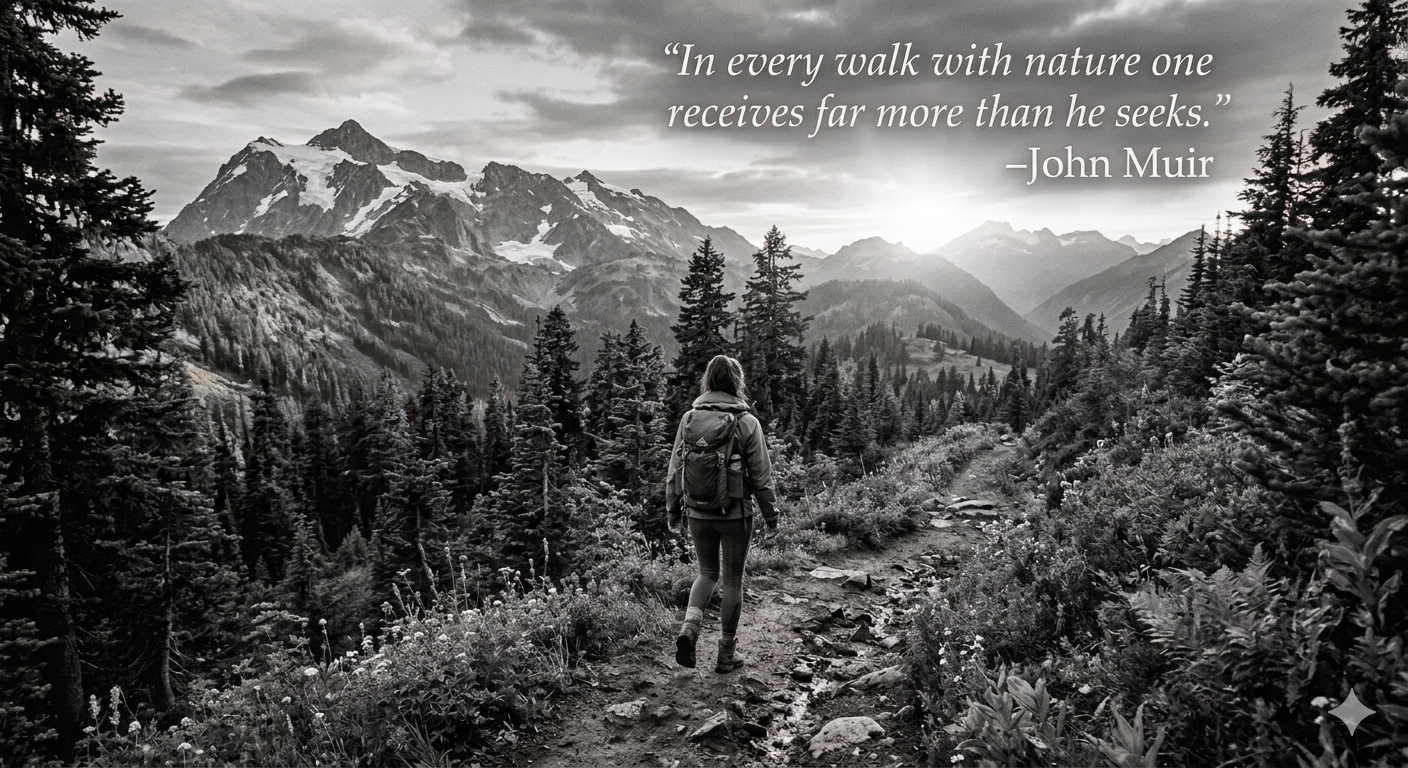
Why Being in Nature Is Not Just a Nice Idea
The relief you feel stepping outside into cool air and soft light is not simply a break from routine. Something measurable happens in the nervous system, and for grief in particular, the natural world offers one thing grief badly lacks: a place with nothing to perform.
There is a particular kind of relief that happens when you step outside, especially when the air is cool and the light is soft and the noise of the day falls away for a moment. Most of us have felt it. We tend to chalk it up to a break from routine, or simply the pleasure of fresh air. But what is actually happening when we spend time in nature goes considerably deeper than that.
Time outdoors does something real to the mind and body. Clinicians and researchers are increasingly treating time in nature not as a pleasant suggestion but as a legitimate intervention, one that produces measurable improvements in psychological well-being and measurable reductions in burnout and stress. Nature, it turns out, is doing something we have only recently begun to understand.
What Nature Actually Does
When we step into a natural setting, something in the nervous system shifts. The relentless mental noise of daily life, the to-do lists, the replaying of conversations, the anticipatory dread, begins to quiet. There is something about the sensory richness of the natural world, the texture of bark, the sound of water, the movement of light through leaves, that draws the mind out of its interior loops and anchors it, briefly, in the present.
This is not a soft or sentimental claim. Clinicians working in structured nature-based therapy settings have documented improvements in psychological well-being that persist long after the formal treatment ends. The benefits are not a temporary lift. They tend to hold.
What also emerges from this work is something less expected: a renewed sense of purpose and autonomy. People who spend time tending growing things, even something as simple as a seedling or a small garden plot, report feeling like active agents in the world rather than passive sufferers within it. Caring for something alive, something that needs you, has a way of quietly recalibrating how we see ourselves.
Nature and the Grief
Grief tends to narrow the world. The couch, the bedroom, the kitchen. The same rooms, the same thoughts, the same loop of memory and longing. Getting outside does not solve any of that. It does not fill the absence or move the timeline forward. But what nature offers is something grief often lacks: spaciousness.
There is something about the scale of the natural world that gently reorganizes our sense of proportion, not by diminishing the loss, but by placing it inside something larger. The grief is still there. But it is held differently when you are standing under a wide sky or listening to water move over rock. The world goes on, not in a way that dismisses your pain, but in a way that makes a little more room for it.
Nature also offers something important for those carrying anxiety alongside grief: a place with nothing to perform. No one to update, no progress to demonstrate, no correct way to be. The trees do not care how well you are grieving. That absence of evaluation, even a brief one, can feel like the first full breath in a long time.
The Body Remembers What the Mind Forgets
One of the quieter benefits of time in nature is what it does for informal mindfulness. Not the structured, sit-down-and-breathe kind, but the more ordinary variety that happens when you are simply moving through the world and paying some gentle attention to it.
A walk in a forest, a slow wander through a garden, a few minutes sitting outside without a phone in hand: these create a kind of low-demand awareness that our indoor, screen-filled lives rarely allow. And in that awareness, something useful tends to happen. Negative thought patterns become more visible, not because we are working hard to identify them, but because the natural world gives the mind just enough to attend to that the loops lose their grip.
This is why so many people report that they think more clearly outside. It is not just the movement or the air. It is that the body is doing something and the surroundings are offering something and the relentless interior monologue, just for a moment, steps aside.
Where to Begin
None of this requires a formal program, a trail map, or an ambitious plan. It requires very little, actually.
A walk in a neighborhood park counts. Sitting near water counts. Tending a few plants on a porch or a windowsill counts. The key is to slow down enough to arrive where you actually are, to let the senses lead rather than the task list. The point is not to exercise or accomplish something. It is to give yourself a few minutes in a place that does not require anything of you, where something living is simply going about its work, and you are welcome to watch.
If you are grieving, I would not tell you that going outside will fix anything. What I would say is this: your nervous system is not indifferent to the natural world. The relief you feel when the air is cool and the light is soft is not a coincidence. It is, in some sense, what you were built for. And on the hard days, that is worth remembering.
Grief is not something you have to figure out on your own. If you're in the thick of it right now — exhausted, overwhelmed, or just unsure what you're even feeling — I'd be honored to sit with you in it. Reach out for a free 15-minute consultation. Let's talk.
The Weight You Were Never Meant to Carry Alone: Using Self-Compassion to Heal Shame and Guilt
Guilt says I did something bad. Shame says I am bad. That distinction matters more than almost anything else in grief and it explains why reasoning with yourself never seems to shift the feeling. Self-compassion works differently and can help take us out of the shame loop.
There is a particular kind of suffering that is different from ordinary sadness or anxiety. It lives deeper, quieter, and often goes unspoken. It whispers that you are not just someone who has done something wrong, but that you are fundamentally wrong — defective, unlovable, beyond repair. That is shame.
And for those who are grieving, shame is a frequent and unwelcome companion.
Shame and Guilt: An Important Distinction
Before we explore how compassion heals shame, it helps to understand what shame actually is and how it differs from guilt.
Guilt says, I did something bad. Shame says, I am bad. This distinction matters enormously. Guilt, while painful, is actually connected to compassion. When we feel genuine guilt, we recognize that our actions affected someone else and we feel a desire to repair that harm. Guilt is oriented outward towards the relationship, towards making things right.
Shame, by contrast, turns inward and becomes an attack on the self. Rather than motivating repair, it tends to trigger what researchers call the threat response: fight, flight, freeze, or appease. We hide. We isolate. We drink, overwork, or lash out. And in doing so, we inadvertently fan the very flames we are trying to extinguish.
As psychologist Dr. Paul Gilbert, founder of Compassion Focused Therapy, explains, the goal in therapy is often to help clients move from shame toward guilt, because guilt at least opens the door to repair and reconnection.
The Three Faces of Shame
Shame takes different forms and it helps to recognize them.
External shame is about how we believe others see us. Often we fear that if people really knew us, they would find us wanting. Internal shame is what we privately believe about ourselves regardless of what others think. We see this as the relentless inner conviction of not being good enough. And then there is the inner critic who is that familiar internal voice pouring fuel on every fire, ensuring that a single mistake becomes a verdict on our entire worth.
What all three have in common is that they thrive in silence and isolation. As Dr. Christopher Germer notes, shame feels blameworthy, isolating, and all-encompassing. However, shame is actually an innocent emotion, a universal one, and a temporary one. The problem is that when we are inside it, it feels like the whole truth about who we are.
Why Logic Alone Doesn't Work
Many of us have tried to think our way out of shame. We remind ourselves that we are being too hard on ourselves, that others have done worse, that we are not defined by our mistakes. And yet nothing shifts. This is what researchers call the "heart-head lag." We can understand something intellectually while our emotional experience remains completely unchanged.
This is precisely why self-compassion is so powerful. It works not by changing our thoughts, but by changing the emotional tone we bring to our experience. Research by Dr. Kristin Neff consistently demonstrates that self-compassion, which is the practice of treating ourselves with the same kindness we would offer a struggling friend, directly reduces shame. It interrupts the threat response and activates what Gilbert calls the "soothing system," creating the safety our nervous system needs to begin healing.
Compassion as the Antidote
So what does self-compassion actually look like when shame is present?
It begins with labeling, i.e., naming what we are feeling. Research shows that the act of labeling an emotion can deactivate the amygdala, the brain's alarm system, reducing its intensity. "This is shame" is not a surrender to it. It is the beginning of perspective.
It continues with common humanity: the recognition that shame, guilt, and the fear of not being enough are not signs of personal failure. They are part of the human experience. Every person who has ever loved deeply has also known the terror of falling short.
And it deepens with tone: the quality of voice we bring to our own inner experience. Gilbert found that clients could reframe their thoughts completely and still feel no relief, because the emotional tone of their inner voice remained harsh and hostile. Learning to speak to ourselves with warmth — the way we would speak to someone we love — is not a soft or sentimental exercise. It is neurologically transformative.
A Note for Those Who Are Grieving
Grief and shame are deeply intertwined. Grieving people often carry shame about how they are mourning — feeling they are too much or not enough, too sad for too long, or somehow failing at the very human act of loss. Some carry shame about the circumstances of a death, particularly in cases of suicide loss or estranged relationships.
If this resonates with you, please know this: grief is not a performance. There is no correct way to mourn. And the shame you carry about your grief is not a reflection of your failure but rather a reflection of how deeply you loved, and how profoundly you have been changed by loss.
Compassion is not about letting yourself off the hook. It is about recognizing that you are a human being doing the impossibly hard work of carrying what you have been given and that you deserve kindness in the carrying of it.
If the voice in your head is harder on you than you'd ever be on anyone else, therapy can help you understand where that comes from — and quietly loosen its grip. I offer a free 15-minute consultation, no commitment required. Schedule a conversation here.
When the Calendar Becomes a Minefield: Grief and the "Minor" Holidays
Valentine's Day built on the assumption of a plus one. Mother's Day after the death of a child. These holidays sting differently because they target the exact relationship you have lost and they are inescapable in every aisle and inbox.
We often talk about the "Blue Christmas" phenomenon—the way the heavy hitters of the holiday season amplify a sense of loss. But there is a quieter, sharper kind of pain that arrives with the holidays that focus on a specific relationship. When the world turns pink and red for Valentine’s Day or fills with floral tributes for Mother’s Day, the grief isn't just general; it’s targeted.
The Specificity of the Sting
For someone who has lost a spouse or significant other, Valentine’s Day can feel like a cruel performance of what they no longer have. It’s a day built on the assumption of a "plus one." Similarly, Mother’s Day or Father’s Day after the death of a child creates a surreal disconnect. You are still a parent, but the traditional ways of celebrating that identity have been severed.
These holidays are difficult because they are inescapable. You see them in the grocery store aisles, in your email inbox, and across every social media feed. They demand a celebration of a bond that, for you, is now defined by absence.
Navigating the "Happy” Hallmark Moment
One of the hardest parts of these days is the well-meaning stranger or acquaintance who offers a cheerful greeting. When your heart is breaking, being told to have a "Happy" anything can feel like a physical blow.
How do you respond when someone says "Happy Mother’s Day" or "Happy Valentine’s Day" and you’re struggling to stay afloat? The most important thing to remember is that you are allowed to opt-out. If Valentine’s Day feels like too much, stay off social media and treat it like any other Tuesday. It’s also important to be gentle with yourself. Grief is exhausting. You don't need to be strong or "get over it." Just getting through the day is enough. Your grief is a testament to the love you shared, and you get to decide how—or if—you want to mark the day.
Grief is not something you have to figure out on your own. If you're in the thick of it right now — exhausted, overwhelmed, or just unsure what you're even feeling — I'd be honored to sit with you in it. Reach out for a free 15-minute consultation. Let's talk.

Mapping a New Reality: Assimilation, Accommodation, and Sudden Loss
After a sudden death you may feel like your brain has gone glitchy, like you are losing your mind. Two psychological concepts explain exactly why and understanding them can make you far more patient with yourself while your mental map is being redrawn.
When you lose someone suddenly—to an accident, a suicide, or a medical emergency—it feels like your world has been physically torn apart. In the aftermath, you might feel like your brain is "glitchy" or that you are losing your mind. The reaction is understandably because you are not just carrying sorrow; you are carrying a shattered world.
In psychology, we use two concepts to explain why your mind feels this way: Assimilation and Accommodation. Understanding these can help you be more patient with yourself as you navigate this impossible terrain. In doing so, we are not seeking to “get over” our grief. Rather, we are learning to build a new mental house large enough to hold both the love you have for the person who died and the loss you are enduring. This is what grief integration means in practice.
Understanding the Cognitive Collision
When we experience a loss, our internal "schema"—the mental map of how the world works—is suddenly at odds with a new, brutal reality.
The Old Schema: "I will grow old with my spouse," or "My child is safe when they leave the house."
The New Reality: The person is gone, and the world is no longer predictable.
Assimilation: Trying to Fit the Loss into the Old World
In the early time period of sudden grief, the mind attempts assimilation. This is the process of trying to fit new, terrifying information into existing schemas without changing the internal map.
In the context of sudden loss, assimilation often manifests as:
Disbelief and Denial: "I keep expecting them to walk through the door."
Searching Behaviors: Scanning crowds for their face or smelling their clothes to maintain their presence.
Ruminative Guilt: The "if onlys." By blaming themselves, the client is often trying to preserve the schema that the world is controllable and fair.
Clinical Insight: We shouldn't rush to "correct" these behaviors. Assimilation is a protective buffer. It is the mind’s way of sipping tragedy in small doses because the full reality is too toxic to swallow at once.
Accommodation: Redrawing the Map
Accommodation occurs when the new information is so massive that the old schema must be completely altered to account for it. This is the "heavy lifting" of grief work. For a survivor of a suicide or accident, accommodation means acknowledging: "The world is not always safe, and I cannot control everything—but I must find a way to live in it anyway."
This involves:
Reconstructing Identity: Moving from "we" to "I."
Integrating the Narrative: Accepting the "before" and "after" as part of one continuous, albeit scarred, life story.
How We can Support Ourselves in the Moment
It may be helpful to visualize your mind as a a GPS map (i.e., a mental map). Before the loss, your map was programmed with certain "rules": If I call, they will answer. When I go home, they will be there. The world is generally safe.
A sudden loss is like a massive earthquake that destroys the landscape. Your GPS is still trying to follow the old roads, but the roads are gone. Accommodation is the difficult, slow process of updating your GPS. You aren't erasing the old map; you are drawing a new one that includes the reality of the loss. Here some tips to navigate the new map.
Lower Your Expectations: Your "processing power" is being used up by this massive mental update. It is okay if you are forgetful, tired, or overwhelmed by simple tasks.
Stop Fighting the "Glitches": If you catch yourself expecting a phone call from them, don't judge yourself. Just gently remind your heart, "That’s my old map. I’m still learning the new one."
Find Small Anchors: When the world feels unpredictable, stick to small routines (like a morning cup of tea) to give your brain a sense of stability.
If you are interested in the role our brain plays in grief, I highly recommend Mary-Frances O’Connor’s The Grieving Brain.

Learning to be Curious About Our Emotions
Most of us apply “be curious, not judgmental” to other people. Turned inward, it changes something fundamental. When we stop labeling emotions as good or bad and start treating them as information, the intensity itself begins to shift.
There is a quote, often misattributed to Walt Whitman, urging us to "be curious, not judgmental." Most of us recognize this as a tool for interpersonal harmony—a way to pause before reacting to a difficult colleague or a grieving friend. But the most transformative application of this concept isn’t necessarily outward; it’s inward.
When we experience emotions such as anger, deep sorrow, or even numbness, our instinct is to label them. We tell ourselves, "I shouldn't feel this way," or "This is a bad emotion." This judgment creates a secondary layer of suffering. Instead, curiosity invites us to treat our emotions as data, not directives.
Emotions as Information
Psychological research, such as the work on Affective Realism and Emotional Granularity by Dr. Lisa Feldman Barrett, suggests that our brains construct emotions as guesses about what is happening in our bodies and the world. From this perspective, an emotion isn’t "good" or "bad"—it is a signal.
Anger might be a signal that a boundary has been crossed.
Guilt might be an invitation to examine our values.
Deep Sadness is often a testament to the depth of our love.
The Power of being an Emotion Scientist, Rather than an Emotion Judger
Studies on mindful emotion regulation highlight that observing emotions without judgment—a core tenet of curiosity—actually reduces their physiological intensity. When we ask, "Where do I feel this in my body?" or "What is this feeling trying to protect?" we shift from being overwhelmed by the wave to becoming the observer of the tide.
By replacing "Why am I like this?" or “this emotion is bad, I shouldn’t feel it” with "what is this emotion trying to tell me?" we create the space necessary to choose our next step, rather than reacting out of habit.
Next time a difficult emotion arrives, try to greet it like a messenger. You don't have to like the message, but being curious about its contents might help you discern what you need in the moment.
If something in this post spoke to you, I'd love to connect. I offer a free 15-minute consultation — a relaxed, no-obligation conversation to see if working together might be a good fit. You can schedule one here.

The Quiet Strength of "Weak Ties": Connecting When It Matters Most
The barista who knows your order. The neighbor you wave to. When close relationships feel too demanding to face, these lighter connections can do something the important ones cannot: offer contact without asking you to be okay.
As a therapist, I often work with individuals navigating significant life challenges: the profound ache of grief, the heavy shroud of depression and anxiety, and the quiet struggle of social isolation, particularly for our senior population. In these times, we naturally lean on our "strong ties" – our closest family and friends. These relationships are invaluable, offering deep emotional support and understanding.
However, there are significant, often overlooked, benefits to nurturing our "weak ties", a concept first explored by sociologist Mark Granovetter. These are the less intimate connections in our lives: the person with whom you briefly chat while walking your dog, the checkout person at the grocery store, or the barista who knows your coffee order. While these exchanges may not offer the same depth of emotional connection as a strong tie, these encounters can be incredibly powerful, especially when we're at our most vulnerable.
For those grieving, weak ties can provide a gentle distraction without the pressure of intense emotional processing. A brief, casual conversation can offer a momentary respite from your deep sadness or a pleasant, low-stakes interaction that doesn't demand you "be okay."
Individuals grappling with depression and anxiety often find the demands of strong ties overwhelming. The fear of burdening loved ones or the energy required for deep emotional engagement can be exhausting. Further, depression and anxiety are pernicious in encouraging us to isolate when, in fact, social connection is often key to our emotional health. Weak ties offer a lighter form of connection. A quick chat at the grocery store or a shared laugh with a distant colleague can provide a sense of belonging and normalcy, boosting mood without the pressure of deep disclosure. These small, positive interactions can be crucial steps in rebuilding confidence and reducing feelings of isolation.
For seniors experiencing social isolation, weak ties can be a lifeline. Retirement, mobility issues, or the loss of loved ones can significantly diminish strong social circles. Engaging with weak ties – a friendly wave to a neighbor, a conversation at a community center, or even a brief exchange with a delivery person – can combat loneliness, stimulate cognitive function, and provide a sense of routine and connection to the wider world. These interactions affirm their presence and value in the community.
In essence, weak ties offer a different kind of support – less intense but no less significant. They provide a broader network of casual interactions that can weave a protective net around us, offering moments of lightness, practical help, and a gentle sense of belonging when strong ties alone might feel insufficient or overwhelming.
To read more about the benefits of weak ties and grief, here is a link to one of my favorite grief websites, whatsyourgrief.org.
If what you've read here resonates, you don't have to keep navigating this alone. I offer a free 15-minute consultation so we can talk about what you're carrying and whether grief therapy might help. There's no pressure and no commitment — just a conversation. Schedule here.

Dosing Your Grief: Healthy Breaks and the Power of 'Puddle Jumping'
Many grieving people believe that stepping away from the pain is avoidance or a betrayal of the person who died. It is neither. There is an important difference between suppression and the deliberate, rhythmic breaks that make grief survivable.
In the challenging landscape of loss, many of us feel pressured to be constantly immersed in our deepest pain—as if taking a break is a sign of avoidance or that our pain is our connection with the person who died. But what if "dosing" your grief—managing the intake of intense emotion—is actually a healthy, necessary form of self-regulation?
I see the benefits of this approach daily in practice. It’s a process distinct from total suppression; it's about conscious, temporary moderation.
The Art of the Emotional Break
When we talk about "dosing" grief, we are recognizing the limits of the human nervous system. As pioneer of loss and death studies Dr. J. William Worden noted in his four tasks of mourning (one of the evidence-based models of grief), grief work is demanding and needs to be balanced with periods of respite. We simply cannot process the full intensity of loss 24/7.
Healthy dosing allows you to:
Prevent Emotional Burnout: Deep sorrow is exhausting. Taking time to focus on daily tasks, hobbies, or light social interaction acts as a crucial energy renewal, allowing you to return to the grief work with more stamina.
Integrate Gradually: Grief is not a switch; it's a dimmer. Dosing allows you to slowly integrate the reality of the loss into your life without being completely overwhelmed or feeling shattered all at once.
From Avoidance to Puddle Jumping
The difference between healthy dosing and harmful avoidance is intentionality.
Avoidance (Suppression): Burying feelings, pretending the loss didn't happen, or using destructive behaviors (like excessive drinking) to numb all emotion. The grief is never acknowledged or addressed.
Dosing (Puddle Jumping): This term is often used in child grief work to describe how children naturally dive into their sorrow (the 'puddle') and then leap out to play, only to return later. Adults can adopt this, too. It means intentionally stepping away from the pain for a planned period—maybe watching a comedy, spending time with friends, or focusing intensely on a project—knowing that you will check back in with your feelings later.
Puddle jumping is an act of agency. It confirms that you are in control of when and how you engage with your pain, rather than letting the pain control you. It’s a rhythmic process of acknowledging the sorrow and choosing joy (or calm) when you need it most.
Give yourself permission to take these necessary breaks. Your strength isn't measured by the depth of your continuous sorrow, but by your capacity to regulate and navigate the waves of loss over time.
If what you've read here resonates, you don't have to keep navigating this alone. I offer a free 15-minute consultation so we can talk about what you're carrying and whether grief therapy might help. There's no pressure and no commitment — just a conversation. Schedule here.

Grief and Holidays
The season rarely resembles what is on the cards and screens and the pressure to be joyful lands hardest on the people least able to manufacture it. Preparation and flexibility help more than willpower and you are allowed to plan your own way through.
For those of us who are grieving, the holiday season rarely lives up to the picture-perfect ideals seen on cards and screens. Following the death of a loved one, the traditional holiday focus on joy and togetherness can feel incredibly challenging.
It is important to put your feelings into perspective. Holiday pressures are real, causing stress even for those not currently grieving. When you factor in loss, that stress level can skyrocket. Do not judge your own emotions. Whether your loss was recent or long ago, a wide range of emotions—sadness, anger, exhaustion, or even surprising moments of peace—are "normal."
Flexibility and preparation can be helpful tools to navigate the holiday season. You can take control by making specific plans and securing the support you need before the season begins. Here is a link to the Griever’s Bill of Rights from the Heartlight Center that may help you understand and express your needs and hopes.
Also, do your best to prioritize self-care. Your physical well-being is closely tied to your emotional resilience. Make sure to eat regular, nourishing meals, get adequate rest, and avoid using alcohol or other substances to self-medicate or numb your feelings.