Losing a Parent as a Child: Why the Grief Returns Decades Later
You were nine, or fourteen, or seventeen when a parent died, and by every visible measure you were “fine.” Now someone else has died and something older has surfaced. Here is why a childhood loss returns in adulthood, what the research actually shows, and why you are not grieving late.
You were nine, or fourteen, or seventeen. A parent died. The adults around you did what adults did then: they got you through the funeral, or kept you home from it, and life resumed. You went back to school. Nobody asked much and you learned not to say much. You were, by every visible measure, “fine.”
Now you are forty or fifty and someone else has died and what has come up is not only grief for that person. It is something older, with the shape of a childhood, and it is louder than anything you expected.
If this is you, you are not unusual and you have not been carrying a secret failure to grieve. Something more specific happened and it helps to name it.
How Common This Is
According to the 2026 Childhood Bereavement Estimation Model from Judi's House, one in eleven children in the United States will experience the death of a parent or sibling before age 18. That is roughly three children in every classroom and most of them grow up to be adults who never received any support specific to the loss.
What the Research Says, and What It Does Not
I want to be careful here because there is a popular story about this that the research does not support. The story goes that grief not expressed at the time gets stored away and eventually surfaces intact, as fresh as the day of the death. When researchers tested that idea by following bereaved adults closely over five years, they found almost no cases of it. Grief does not sit in a reservoir waiting for a crack in the dam.
What the research does find is more useful and more humane.
A UK study followed adults who had lost a parent in childhood, some of them more than seventy years after the death. The lasting difficulties they described, with trust, self-worth, loneliness, and being able to say what they felt, tracked three things closely. Whether their world stayed stable after the death or fell apart (a move, a separation from siblings, a surviving parent who could no longer function). Whether anyone supported them directly rather than focusing only one the grieving adult in the house. And whether anyone told them the truth, in language they could understand, about what was happening.
One participant, seventeen when his father died, put it plainly: everyone assumed a seventeen-year-old boy could cope so nobody said anything at all.
Read that way, the child who lost a parent did not fail to process anything. The conditions for processing were never provided. A child cannot grieve alone what the adults around them will not name.
Why It Comes Back Now
Grief researchers use the term “regrief” for what happens next: a childhood loss gets grieved again at each new stage of life, because the person now has capacities they did not have before, and because the loss keeps taking new things. The wedding your mother should have attended. The first time you held your own child and understood, in your body, what your father had lost. The moment you passed the age he was when he died.
A new death in adulthood is often the largest of these moments. It is frequently the first time you have three things you lacked at nine: the maturity to understand the loss, permission to fall apart, and language for what you feel. So two griefs arrive together, and the older one is sometimes the louder of the two. That is not regression. It is the first real opportunity you have had.
What This Can Look Like
Some patterns I see often in adults who lost a parent young:
Feeling like a fraud in your own grief. The new loss is real and you are grieving it, but you sense that the intensity belongs somewhere else, and you are not sure you are allowed to say so.
Not knowing basic facts. Many people who lost a parent in childhood were never told how the person died, or what the illness was, or what the last weeks were like. Decades later, that gap is still a gap.
A tight, self-sufficient way of being in the world. If you learned early that no one was coming, you may have built a life around not needing anyone. That skill was earned honestly. It also tends to get in the way of being helped now.
Difficulty picturing the parent as a person. You knew them as a child knows a parent. You have never had the chance to know them as an adult would, and the grief now includes that missing relationship. This is one place where continuing bonds can do real work: asking relatives what they were like, finding letters, learning the ordinary details.
What Tends to Help
Start by taking the earlier loss seriously as a loss of its own, not as a complication of the current one. It deserves its own room.
Fill in what you can. Ask the surviving relatives the questions no one answered. Some will not want to talk. Some have been waiting thirty years for someone to ask.
Let the identity questions come. Who you are was shaped by that death more than you may have realized and revisiting it now, as an adult, is part of how a childhood loss finally gets integrated rather than simply survived.
And if you are a parent making decisions for a grieving child right now, the research above is a clear argument for telling them the truth and letting them participate in what is happening. The adults who spared you were trying to protect you. You can do it differently.
A Final Word
If you lost a parent as a child and something old has surfaced now, you are not grieving badly or late. You are grieving a loss you could only meet in part as a child, and you are meeting it again with everything you have become since. That is worth doing carefully and it is worth doing with someone.
I offer a free 15-minute consultation at shareyourgrief.org. No pressure, no commitment, just a conversation.
Who Are You Now? What Loss Does to Identity
Not knowing what to make for dinner because you have not had to choose alone in years. Struggling to picture a future that was built around someone no longer in it. This disorientation is not fragility and it is one of the most predictable and least discussed features of significant loss.
There is a question that surfaces for many grieving people, one that can feel strange or even embarrassing to say out loud: who am I now?
It shows up in small, disorienting moments. Not knowing what to make for dinner because you have not had to choose alone in years. Struggling to picture your own future because it was built around a life that included someone who is no longer in it. Feeling unmoored in a way that has nothing to do with sadness and everything to do with not quite recognizing yourself.
If this is familiar, you are not being fragile. You are encountering one of the most predictable and least talked about features of significant loss.
The Self We Build in Relationship
We build our identities with other people, not in isolation. This is not a poetic observation; it is developmental fact. From childhood onward, our sense of who we are is shaped by the people closest to us, by how they see us, by what we become in their presence. By the time a relationship has years or decades behind it, the line between "who I am" and "who I am with this person" can be genuinely hard to locate.
So when someone central to that self dies, the disruption is not a side effect of grief. It is grief, expressed at the level of the self. None of this means something is wrong with you. It means your identity is doing exactly what identity does when a foundation it was built on disappears.
The Beliefs You Did Not Know You Had
Part of what makes this so disorienting is that most of us do not know these assumptions are there until loss breaks them open. Psychologist Ronnie Janoff-Bulman's research on what she calls the assumptive world identifies a few beliefs that quietly undergird most people's sense of security: that the world generally makes sense, that it is not senselessly cruel, that we are safe.
We rarely notice these beliefs consciously. We simply live as though they are true until something happens that makes them impossible to hold onto. Major loss, especially sudden loss, can shatter them at the root. That shattering is part of why grief can feel disorienting well beyond sadness. It is not only your heart that is hurting. It is your whole framework for how the world works.
The Questions That Surface
Some of the identity questions grief raises are immediate and practical. Am I still a wife if my husband has died? A father if my child is gone? These titles carry so much of who we understand ourselves to be and after a loss they can feel like they belong to a life that no longer exists even while the relationship itself still feels present in other ways.
Other questions arrive more slowly. What do I do with the years I assumed I had? Who am I outside the role that organized so much of my time and attention? What do I actually want now that the future I was building has to be reimagined from a different foundation?
There is no need to answer these quickly and trying to usually backfires. This is not something you decide. It is something you discover gradually by living a life that has no precedent for you yet.
What This Growth Actually Looks Like
Carrying a lost identity forward rarely happens as one clear moment of clarity. It tends to show up in a few different ways.
Some of it happens through carrying the person forward. Taking on values, habits, or ways of being that belonged to someone you lost is not just a way of remembering them. It is a way of living alongside a self that includes them.
Some of it happens through discovering capacities you did not know you had. Loss can push people into skills and roles they never needed before: managing finances for the first time, taking on new tasks or chores, traveling alone. These are not just coping mechanisms. They are new parts of who you are.
Some of it happens through renegotiating relationships. Friendships sometimes fade after a death, not from unkindness but because they were built around a context that no longer exists. New connections often form in their place, sometimes with people who understand this particular kind of loss.
And some of it, the hardest part to describe, happens simply through the accumulation of days in which you were still here, still making small decisions, still choosing what comes next.
A Note on "Finding Meaning"
You may have heard that loss can lead to what researchers call post-traumatic growth: more appreciation for life, deeper relationships, a clearer sense of purpose. This does happen for some people and it is real when it does.
But it is not a requirement and it cannot be forced. If your loss has not produced a lesson you can name or a purpose you can point to, you are not doing grief wrong. You are simply living with a loss which is its own form of work.
Questions Worth Sitting With
You do not need to answer these. They are meant to be companions, not assignments.
What did I understand about myself only in relation to this person and how do I relate to that part of myself now?
Is there a value or way of being of theirs that I notice showing up in me?
What is one small capacity I have discovered in myself since this loss?
Where do I feel most like myself these days, even briefly?
A Final Word
You are not the same person you were before this loss. You are also not only the person the loss made you. You are in the process of growing around both, carrying what remains while living alongside what has changed. That process is slow by nature and that is not a failure to move forward. It is what integrating a loss actually looks like.
If this resonates and you would like support working through it, I offer a free 15-minute consultation. No pressure, no commitment. Just a conversation.
What Happens to the Soul? Embedded Theology and the Fear We Can't Quite Shake
A fear that arrives in the hour before sleep, asking where your loved one is now. It can grip people who left religion decades ago and would tell you plainly that they do not believe in hell. Here is why a belief you consciously rejected can still land with physical weight.
What Happens to the Soul? Embedded Theology and the Fear We Can't Quite Shake
There is a particular kind of fear that may surface after certain losses, one that rarely gets spoken aloud even in a therapist's office. It can arrive in the hour before sleep or in the quiet after a hard conversation. It sounds something like: where are they now?
This fear can surface after almost any loss, but it tends to arrive hardest after a death that carries its own history of judgment, a loss that a person's childhood faith would have had something specific and often severe to say about. People find themselves gripped by fear for someone's fate even though they no longer consider themselves religious, and even though they would tell you they do not believe in hell, or in a god who judges people this way, or in an afterlife of any kind.
The fear tends to arrive anyway and it can arrive with real physical weight: a tightness in the chest, a jolt of dread that lands before conscious thought has time to catch up. For many people this is disorienting on its own terms. How can a belief you have consciously rejected still have this much power over you?
If this describes something you have felt, you are not being irrational and you have not secretly stayed religious without noticing. What you are experiencing has a name and understanding it can loosen its grip.
Two kinds of belief
Theologians Howard Stone and James Duke describe two different types of belief a person carries. “Embedded theology” is what we absorb before we are old enough to evaluate it: the ideas soaked up through sermons, religious education, prayers, and the general emotional atmosphere of a religious upbringing. “Deliberative theology” is what we arrive at later through conscious thought and choice.
When someone leaves a faith community, their deliberative theology tends to change quickly. They can tell you what they no longer believe. Embedded theology moves at a different pace. It was not installed through argument so it does not respond to argument alone. It was installed through repetition, emotional intensity, and the authority of the adults who taught it, which is exactly why it can persist underneath a belief system a person has otherwise rejected for years.
Why this shows up hardest after certain losses
Many religious traditions have, at different points in their history, treated suicide as a defining moral failure rather than what clinicians now understand it to be: an outcome of unbearable pain. Someone who grew up hearing that framing, even indirectly, may carry a specific, vivid verdict rather than a vague unease, one that resurfaces in force after this particular kind of loss.
A related pattern can show up after the death of a loved one whose sexual orientation or gender identity was treated as a source of shame or condemnation by the faith community they, or their family, belonged to. Here too, the fear is rarely a general spiritual unease. It is often a specific claim a person heard stated outright as a child, about a specific kind of person now attached to someone they loved.
What makes this fear so hard to shake, in either case, is the specificity. Not a vague sense that religion disapproves of something, but a fully formed verdict, complete with language, that the grieving mind can retrieve intact decades later.
This sits alongside, but is distinct from, the social stigma that can surround these losses. What we are talking about here is quieter and more private: a fear about the deceased's fate that a person may never say aloud to anyone, sometimes because they feel foolish for having a fear rooted in a belief they no longer hold.
Why grief pulls it back to the surface
Grief is exhausting in a way that overwhelms our capacity for reflective thought. Under that kind of depletion, the mind tends to default to whichever framework was installed first, not whichever one it currently endorses. This lines up with a body of research on what psychologists call religious residue. A 2021 study followed people who no longer identify as religious, sometimes called religious dones in this research, and found their endorsement of core moral intuitions consistently falls between that of currently religious people and people who were never religious, rather than matching either group cleanly. The same body of research found this residue can fade somewhat with time, but for many people it persists well into adulthood. That fits what shows up clinically: a belief a person consciously set aside years ago can still be the one their mind reaches for at 2 a.m.
This isn't a referendum on faith
None of this is an argument for or against any particular tradition. Some people find real comfort in returning to an old prayer or ritual during grief and that can be a genuine way of staying connected to the person they lost, not something that needs correcting. The goal here is not to talk anyone out of a belief. It is to help you recognize where a reaction is coming from, so you can meet it with more clarity and less shame.
Noticing the old voice
You likely cannot argue the fear away in the moment it arrives and trying to usually backfires. What tends to help more is naming it for what it is. Instead of "they are being judged," try "I am having the thought that they are being judged." That small shift creates distance between you and the belief, enough distance to remember that you get to decide what to do with it.
Questioning this is not a betrayal of the person you lost and it is not a betrayal of the family or community that raised you. It is part of the same work grief always asks of us: understanding what we are carrying, so we can choose, with open eyes, what to keep and what to finally set down.
If this resonates and you would like support working through it, I offer a free 15-minute consultation. There is no pressure, just a conversation. Schedule here.
Anger in Grief
The world is prepared for your sadness. It is far less prepared for your anger at the person who died, at the doctors, at friends who said the wrong thing. Underneath that anger there is almost always a fear that anger is “wrong” or that you’re a bad person for feeling it. Neither is true.
When someone you love dies, the world expects you to be sad. Sadness makes sense to people. It is visible, it is legible, and it fits the cultural script. What the world is far less prepared for is the anger.
And yet anger is one of the most common emotions in grief. Many of my clients are surprised by it, even frightened by it. They feel furious at the person who died for leaving them. They feel rage at the doctors, the universe, the friends who said the wrong thing. Sometimes the anger has no clear target at all, just a heat that rises without explanation and burns without a source. And underneath the anger, almost always, is the fear that feeling it makes them a bad person.
It does not.
Why Anger Makes Perfect Sense
Grief researchers have long recognized anger as a central, not peripheral, feature of mourning. Dr. J. William Worden, whose four tasks of mourning remain one of the most clinically grounded frameworks for understanding loss, identifies anger as a normal and expected response to bereavement. It is not a sign that something has gone wrong in your grieving. It is often a sign that it is going right.
To understand why, it helps to think about what loss actually does to us. When someone we love dies, we lose not just a person but a future, a sense of safety, a set of assumptions about how the world is supposed to work. That disruption is not just sad. It is threatening. And when we feel threatened, we get angry.
From a neurological perspective, anger is often a secondary emotion, one that arises in response to something more vulnerable beneath it. Fear. Helplessness. The raw exposure of loving someone and losing them anyway. Anger is, in many ways, the nervous system's preferred alternative to powerlessness. It is energy where grief is collapse. It is movement where loss is stillness. And for many people, it arrives before they have the language for what else they are feeling.
The Targets Are Many, and Often Surprising
One of the things that makes grief anger so disorienting is how many directions it can point at once.
Some people feel anger at the person who died. This is particularly common after a death that felt preventable, a suicide, an overdose, an accident, or a person who refused to see a doctor until it was too late. The anger makes sense: they left. They made choices that took them away. Even when those choices were driven by illness or by forces beyond their control, the loss can feel like abandonment. Feeling furious at a person you loved deeply is not a betrayal of that love. It is evidence of it.
Others feel anger at the people around them. At the friend who disappeared. At the relative who said the wrong thing. At the colleague who seemed to move on immediately. Grief is relational, and the ways others fail us in our loss are real and often worth acknowledging. The sting of those failures can linger long after the initial weeks of mourning.
Some feel anger at God, or at a universe that allowed this to happen. Some feel anger at themselves, looping through the "if onlys" in search of the place where they could have changed the outcome. Some feel anger and cannot name its source at all. Just a background heat that rises at unexpected moments and leaves them feeling ashamed.
All of these are normal. None of them make you a bad person.
Where the Shame Comes From
Grief anger is one of the most poorly supported emotions in our culture. We are comfortable with tears. We are less comfortable with rage, particularly when it is directed at someone who has died or at the people trying to help.
This discomfort has consequences. Many grievers learn quickly to hide their anger, or to express it in indirect and often self-destructive ways. They snap at people they love. They withdraw. They work too much or drink too much or spend too much, anything to channel the energy somewhere it will not make others uncomfortable.
What gets lost in this suppression is the information the anger was carrying. Anger in grief almost always has something to say. It may be pointing toward a genuine loss of trust, a relationship wound that deserves attention, or a place where the mourner needs to set a limit or ask for something they are not getting. Suppressing it does not resolve any of those things. It just drives them underground.
Working With the Anger, Not Against It
The goal is not to eliminate grief anger. The goal is to understand it well enough to work with it.
The first step is simply allowing it to exist. This sounds obvious and is harder than it sounds. Many grievers have spent months or years telling themselves they should not feel this way, that it is wrong or selfish or ungrateful. Getting curious about the anger, rather than immediately judging it, is often the beginning of something useful.
The second step is to look beneath it. When you notice the anger rising, it can help to ask: what else is here? Underneath the fury at your brother for not being there when your mother died, there may be grief about the relationship itself, or fear about who carries the family now. Underneath the rage at a doctor's missed diagnosis, there may be a devastating sense that the world is not as safe as you believed. The anger is real. But it is often pointing toward something that also deserves attention.
The third step is to find expression that is neither suppression nor explosion. Physical movement can help: anger is energy, and the body often needs somewhere to put it. Writing, particularly unsent letters to the person who died or to the people who failed you, can create a container for things that need to be said without requiring you to actually say them. In therapy, anger is something we can sit with carefully and follow to its source.
A Note on Anger and Guilt
Anger and guilt are close companions in grief, and they frequently travel together. The person who feels furious at a loved one who died by suicide may also feel crushing guilt for having felt that anger at all. The person who is angry at the doctors may also feel guilty for not having pushed harder or asked the right questions.
If that combination is familiar to you, please know this: feeling angry does not mean you did not love the person. It does not mean you are glad they are gone. It does not mean anything, except that you are a human being responding to an unbearable loss in one of the most human ways possible. The anger and the love can coexist. They almost always do.
Getting Support
Grief anger can be one of the loneliest parts of loss, precisely because it is the part people feel least able to share. If you are carrying anger alongside your grief and not sure what to do with it, therapy can be a place to bring it without having to manage how it lands on someone else.
You do not have to figure this out alone. If you would like to talk, I offer a free 15-minute consultation at shareyourgrief.org. No pressure, no commitment. Just a conversation.
What Is Grief Integration? A Plain-Language Guide to the Term Therapists Use Instead of "Moving On"
Therapists keep using this phrase instead of the familiar language of moving on and the difference is not academic. Understanding what integration actually means can change how you relate to your own grief, particularly if you have been wondering whether you are stuck.
If you have spent any time in grief therapy, or read anything about loss in the past decade, you have probably encountered the phrase grief integration. It shows up in books, in clinical handouts, in the language therapists use. But what does it actually mean? And why do grief counselors keep using it instead of the more familiar language of "healing" or "moving on"?
This post is an attempt to answer those questions plainly, because the concept matters. Understanding it can genuinely change how you relate to your own grief.
Why "Moving On" Falls Short
The cultural script for grief is familiar: you feel the loss, you work through it, and eventually you move on. The grief recedes. Life returns to something like normal.
The problem is that this script doesn't match what most people actually experience. For the vast majority of bereaved people, the loss doesn't recede. The person who died doesn't become less important. The relationship doesn't fade into the background. And for many grievers, the expectation that it should (that this is what "healthy" grief looks like) becomes its own source of shame and confusion.
Am I stuck? Is something wrong with me? Why haven't I moved on yet?
The concept of grief integration offers a different and, I would argue, more honest framework.
What Integration Actually Means
Grief integration is not the disappearance of grief. It is the reshaping of it.
Dr. M. Katherine Shear of the Columbia Center for Complicated Grief, one of the leading researchers in this field, describes it this way: grief begins as an acute experience, intense, disruptive, and all-consuming. Over time, through a natural mourning process, that acute grief is gradually reshaped into something quieter. It doesn't vanish, but it becomes woven into the fabric of a person's daily life rather than dominating it.
Integrated grief, in Shear's framework, is grief that allows you to remember and honor the person you lost without that grief continually derailing your ability to function and find meaning. The loss remains real and present. The love remains real and present. But the pain no longer occupies every room.
Think of it this way: in the early days of loss, grief is the whole house. Integration is the process by which your life (your capacity for joy, connection, and purpose) slowly grows larger around it, until grief becomes one room among many rather than the only room you can inhabit.
What the Mourning Process Involves
Integration doesn't happen passively, and it doesn't happen on a schedule. But research suggests that certain things tend to support it.
One is “dosing”: the natural rhythm of moving toward grief and then away from it. Bereaved people instinctively learn to spend time with their pain, and then let their minds turn toward something else, and then return. This isn't avoidance. It's regulation. It's the mind's way of managing what would otherwise be an unbearable continuous exposure to loss.
Another is “continuing bonds”: the gradual discovery that a relationship with someone who has died doesn't have to end; it simply changes form. Memories, values, rituals, and a felt sense of connection can all become ways of maintaining a relationship with someone who is gone. This is not denial. It is one of the most natural and healthy aspects of mourning.
Integration also involves adjusting to the practical and identity-level changes that loss creates, many of which are losses in their own right. Who are you now? What does your daily life look like without this person in it? These questions don't have fast answers, but sitting with them, and slowly finding new answers, is part of how integration happens.
Integration Is Not the Same as "Getting Over It"
This distinction matters enormously, and it is worth saying plainly: integrated grief is not resolved grief. You do not stop loving the person. You do not stop missing them. Grief integrated into your life is still grief.
What changes is the relationship between your grief and your life. Early in loss, grief tends to crowd everything else out. Over time, for most people, life gradually reclaims space alongside the grief. The two coexist. You can hold both the weight of the loss and moments of genuine happiness, connection, and even joy. Not because the loss has become less real, but because you have grown larger around it.
When Integration Doesn't Happen
For some people, the natural mourning process stalls. Grief researchers sometimes call this “complicated grief” or, in clinical language, Prolonged Grief Disorder: a state in which acute grief persists long past the point where integration would typically have begun. If you feel genuinely stuck, if the pain remains as raw and disorienting as it was in the earliest days of your loss, that is worth paying attention to. It is not a character flaw, and it is not permanent. It may be a signal that some additional support could help.
A Final Thought
You will never "get over" the death of someone you loved. You aren’t supposed to. Integration is not about leaving them behind. It is about learning to carry them with you, in memory, in love, in the values and habits and ways of being they shaped in you, while also stepping back into your own life.
That is not moving on. That is moving forward. And there is a profound difference.
If you are struggling with grief and wondering whether what you are experiencing is typical or something more, I am happy to talk. You can schedule a free consultation here.
Am I Stuck? When Grief Becomes a Cage
Carrying grief for years is not a psychological failure. But grief can lose its fluidity and become something more like a cage and there is a clinical name for that. Here is how to tell the difference, with questions to help you notice the growth you may be missing.
Grief is not a disease, and that truth does not change simply because you continue to carry it beyond an artificial timeframe. Whether it has been one year or ten, the presence of grief is not a symptom to be cured, but a reflection of a bond that continues to exist. We must be careful not to mistake the enduring nature of grief for a psychological failure.
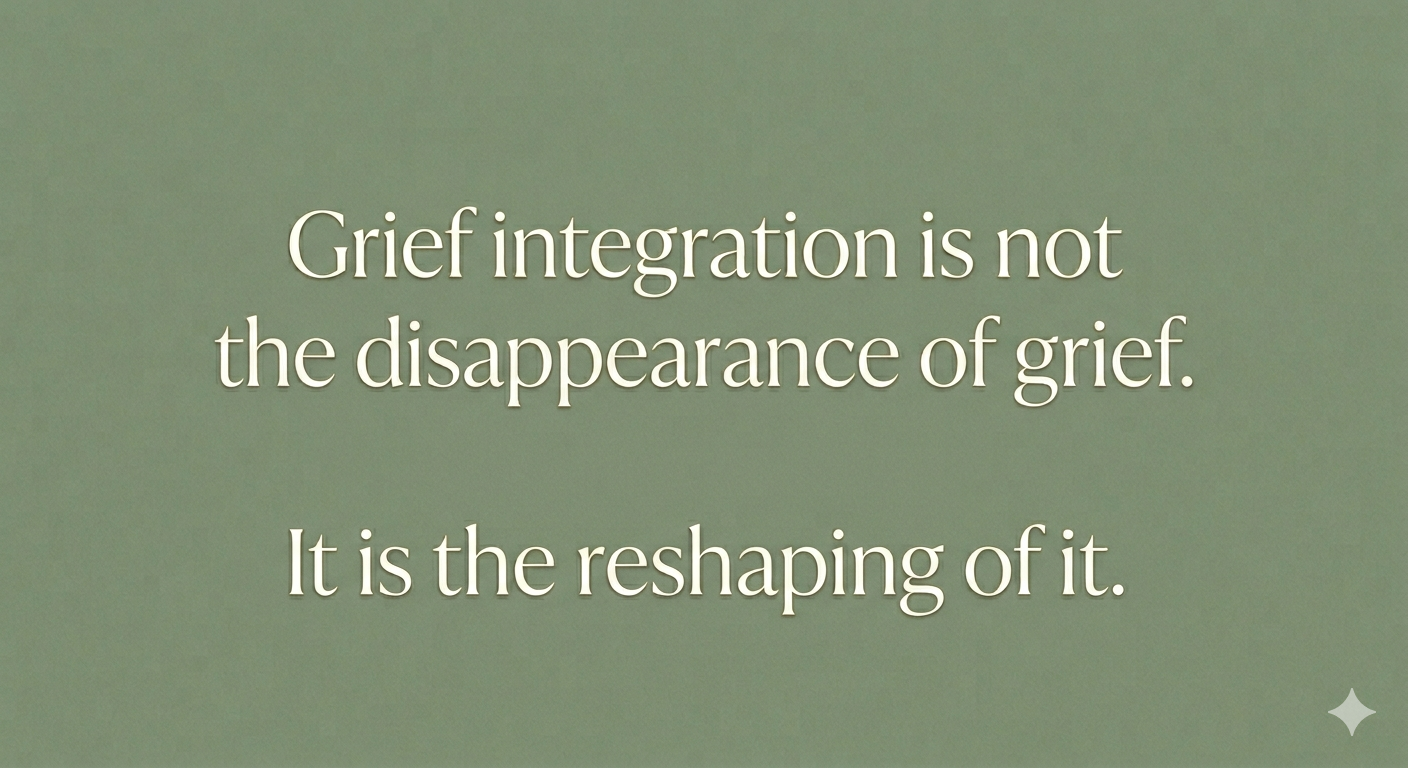
At the same time, it is possible for the grieving process to lose its fluidity. There is a point where grief stops being a heavy, somber companion on your journey and starts becoming a cage: a place where the walls feel fixed and the exit feels barred. In the clinical world, we have defined this specific experience of "cage-like" or “stuck” grief: Prolonged Grief Disorder (PGD).
When Grief Becomes "Prolonged"
The inclusion of PGD in the DSM-5-TR was controversial, and for good reason. Grief is the natural reaction to loss. As such, pathologizing grief can be injurious and another way our society stigmatizes grief and grievers. There are times, however, where the PGD diagnosis allows us to identify when grief has derailed and our grief reactions are entrenched to the point that we cannot pursue a meaningful life.
For adults, we cannot diagnose someone with PGD within the first 12 months of the loss (for children this time period is 6 months). PGD is characterized by a persistent longing for the deceased or a preoccupation with thoughts and memories of the person who died. Beyond that, we look for "traffic jams" or “derailers” that occur nearly every day, such as:
Identity Disruption: Feeling as though a part of oneself has died.
Avoidance: Intense efforts to avoid reminders that the person is gone.
Emotional Numbness: An inability to experience positive emotions.
Life Interruption: Significant difficulty engaging with friends, interests, or planning for the future.
The Distinction: Stuckness vs. Integration
The difference between PGD and "regular" (though painful) grief is often one of stagnation versus movement. PGD feels like being caught in a circular storm where our acute grief persists long after the loss occurred.
Integration, by contrast, feels like a slow, erratic tide. If you feel like your grief hasn’t shrunk, you’re right; it hasn’t. But you aren’t "stuck" just because the pain remains the same size. Think of your grief like a stone in a jar. In the beginning, that stone fills the entire jar. As time passes, the stone doesn't get smaller, but the jar—your life, your hopes for the future, your capacity for joy—starts to grow larger around it.
Questions for Reflection: Identifying Your Growth
When that "stuck" feeling becomes overwhelming, take a moment to look at the landscape of your life. These questions can help you notice the subtle shifts of integration:
The "And" Factor: Can I hold two seemingly opposite things at once? Am I able to feel a moment of beauty and the weight of my loss in the same afternoon?
The Shape of the Day: Is my grief an all-consuming fog, or is it a heavy backpack that I am learning to wear as I go about my day?
The Narrative Shift: When I think of them, am I beginning to have "visits" from happier memories rather than just the trauma of the end?
The Quiet Growth: In what ways has my perspective on compassion or "what matters" expanded because of this loss?
A Final Thought
You aren't a project to be finished or a problem to be solved. You are a person who has been changed by a profound loss. Integration isn't the absence of pain; it’s the presence of the loss within a functioning, meaningful life. If you still feel the weight, it doesn't mean you’re standing still: it means you’re carrying something significant as you move forward.
Grief is not something you have to figure out on your own. If you're in the thick of it right now — exhausted, overwhelmed, or just unsure what you're even feeling — I'd be honored to sit with you in it. Reach out for a free 15-minute consultation. Let's talk.
The Myth of Closure: Why Integrating Grief Doesn’t Mean Saying Goodbye
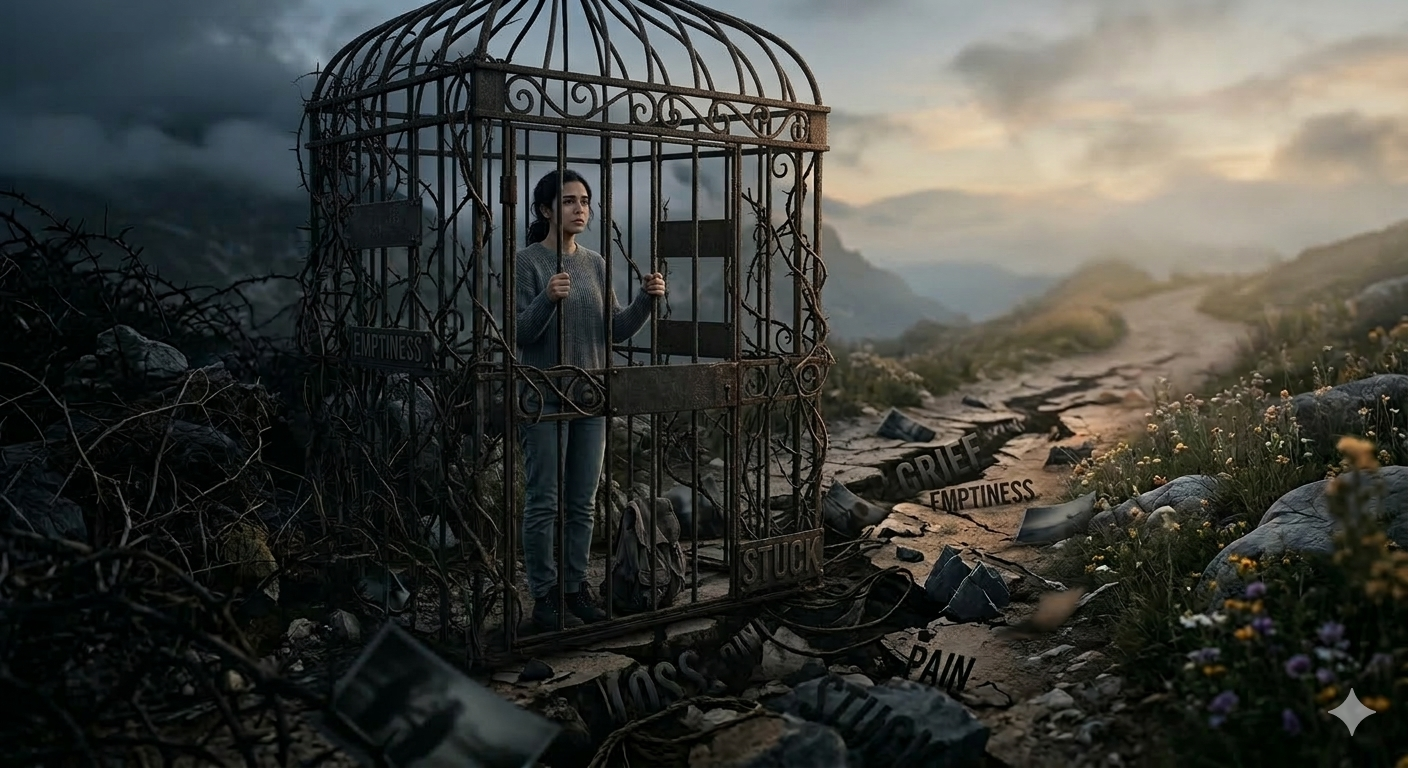
Closure suggests a door swinging shut. For anyone who has lived through deep loss, it often lands as an insult. Human beings are not built for closure and the wave of grief that hits you years later is not a failure. It is evidence of an enduring bond.
We are often told that the goal of grieving is "closure." The word itself suggests a neat and tidy conclusion—a door that swings shut, a book that is finished, a chapter that is permanently left behind. Friends and family might use this word with the best of intentions, hoping for the day you can finally "move on" and return to the person you were before.
But for those who have lived through deep loss, the word closure often feels like an insult. It implies that if we just work hard enough, we can somehow sever the bond with the person we lost.
Why Closure is a Cultural Fiction
The reality is that human beings are not designed for closure. Our brains are hardwired for attachment. When we love someone, they become part of our internal map—their voice, their values, and their presence are woven into our own identity. Death ends a life, but as pioneer Pauline Boss famously argued, it does not end a relationship.
Seeking closure is often an exercise in frustration because it sets up a false finish line. When you inevitably feel a wave of grief years later—triggered by a song, a scent, or a milestone—you may feel like you’ve "failed" at healing. In truth, that wave isn't a sign of failure; it’s a sign of the enduring nature of love.
Moving Forward, Not Moving On
If the goal isn’t closure, what is it? In grief therapy, our goal is integration: learning to live with our loss and pursue a life that is meaningful to us.
Instead of trying to close a door on the past, we learn to carry the absence with us. We move forward with our grief, not away from it. This is often called "Continuing Bonds." It means finding a new way to relate to the person who died—perhaps through rituals, through living out the values they taught us, or simply by acknowledging that they are still a part of our "inner committee."
Letting Go of the Pressure
If you are waiting for a day when the loss no longer matters, you are waiting for a day that will never come—and that is actually okay. You don't need to "resolve" your grief to live a beautiful, meaningful, and even joyful life.
Integrated grief is not about the disappearance of the pain; it is about the expansion of your world around that pain. You are allowed to be a person who carries this absence forever. You are allowed to keep the door open.
Grief is not something you have to figure out on your own. If you're in the thick of it right now — exhausted, overwhelmed, or just unsure what you're even feeling — I'd be honored to sit with you in it. Reach out for a free 15-minute consultation. Let's talk.
The One-Year Myth: Why Your Grief Doesn’t Have an Expiration Date
We treat the first anniversary as a finish line where mourning should be complete. The clinical truth is close to the opposite: the one-year mark is often among the hardest stretches, not the end of one. If you feel worse at fourteen months than four, you are not backsliding.
One of the pernicious myths regarding grief is that something happens at the end of the first year following a loved one’s death where the griever miraculously feels “better.” When this does not occur, they may look at the calendar with a sense of impending failure, asking some version of the same question: “Why don't I feel better yet? Am I doing this wrong?”
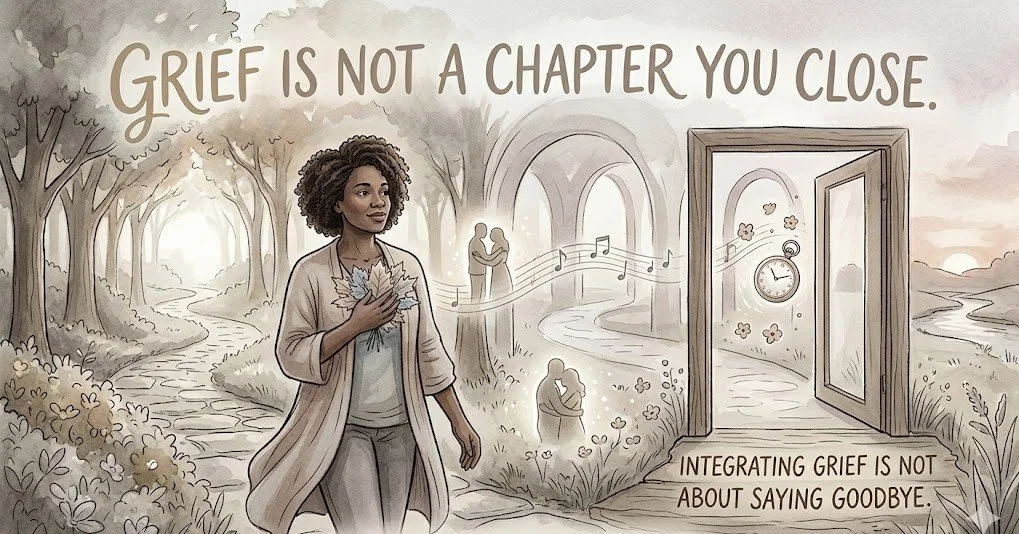
We have a cultural obsession with the "one-year" milestone. We treat it like a finish line—a magical threshold where the heavy lifting of mourning should be complete and we should "return to normal."
But here is the clinical truth: The one-year mark is often one of the hardest parts of the journey, not the end of it.
Why the "One-Year" Timeline is a Fiction
The idea that grief fits into a neat 365-day box is not based on human psychology; it’s based on a calendar. In reality, the first year is often spent in a state of "survival shock." Your brain is busy rewiring itself to a world that no longer contains your loved one.
When that first anniversary hits, the "protection" of shock often wears off. You aren't "backsliding" if you feel more pain at fourteen months than you did at four; you are simply more present for the reality of the loss.
Grief is Not a Task to Finish
Instead of a staircase we climb (where the top is "recovery"), think of grief as a landscape you learn to live in.
You don’t "get over" it: You grow around it.
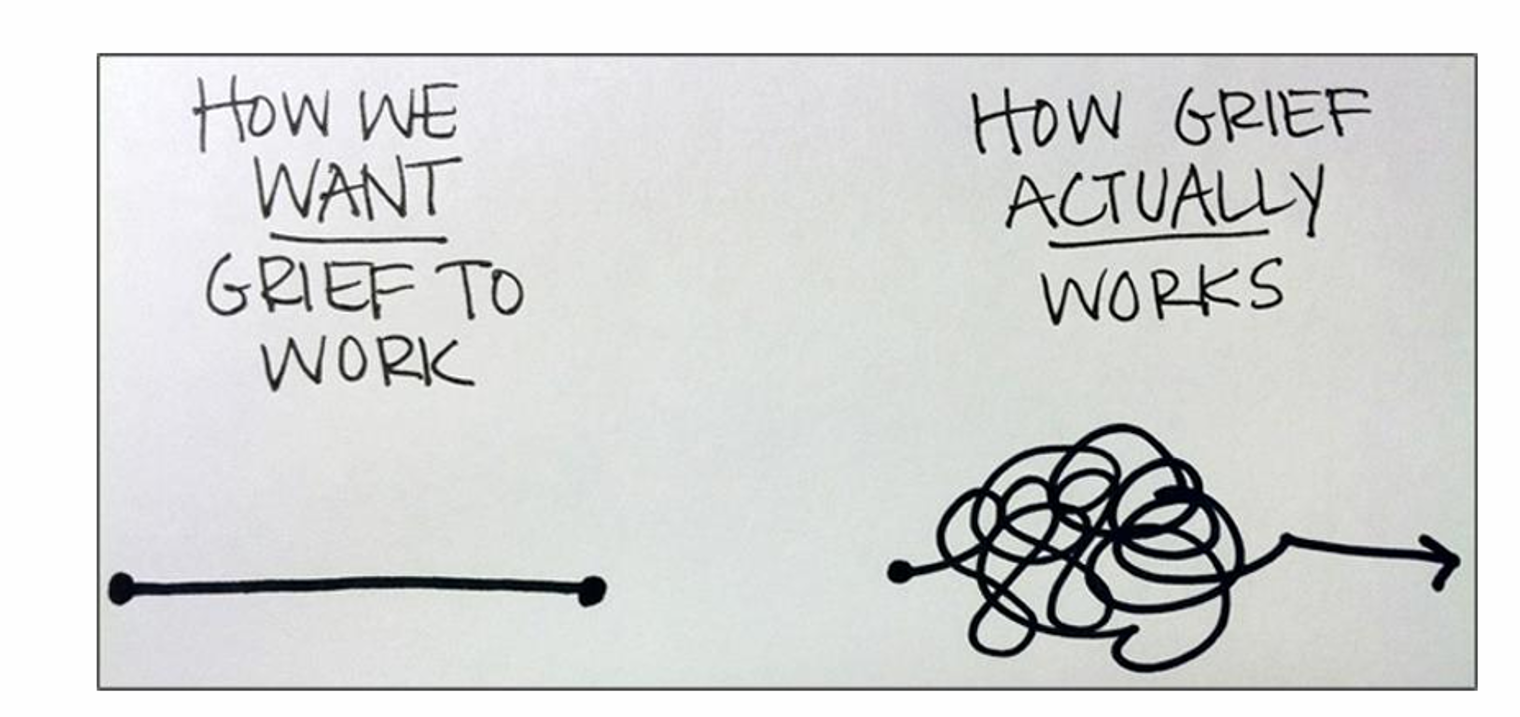
Progress isn't linear: It looks more like a scribble than a straight line.
The "Second Year" is real: Many people find the second year more challenging because the initial casseroles have stopped arriving, the check-in texts have slowed, and the permanent nature of the loss finally sinks in.
If you are past the year mark and still feeling the weight of your loss, you aren't "stuck." You are grieving. And grieving is a testament to the depth of the love that preceded it.
A Note on the "No Major Decisions" Rule
You’ve likely heard the well-meaning advice: “Don’t make any major life changes in the first year.” While this is designed to protect people from impulsive choices made in a while we’re experiencing brain fog, it isn't a universal law.
For some, staying in the family home is a source of daily trauma. For others, a career change or a move provides a necessary "fresh start" that aids their healing. Clinical wisdom suggests we should pause and evaluate, but we shouldn't paralyze ourselves. If a decision is born out of a need for safety, peace, or survival, "waiting out the clock" isn't always the healthiest choice. Sometimes, the most empowered thing you can do is trust your own internal compass, even when the world tells you to wait.
If what you've read here resonates, you don't have to keep navigating this alone. I offer a free 15-minute consultation so we can talk about what you're carrying and whether grief therapy might help. There's no pressure and no commitment — just a conversation. Schedule here
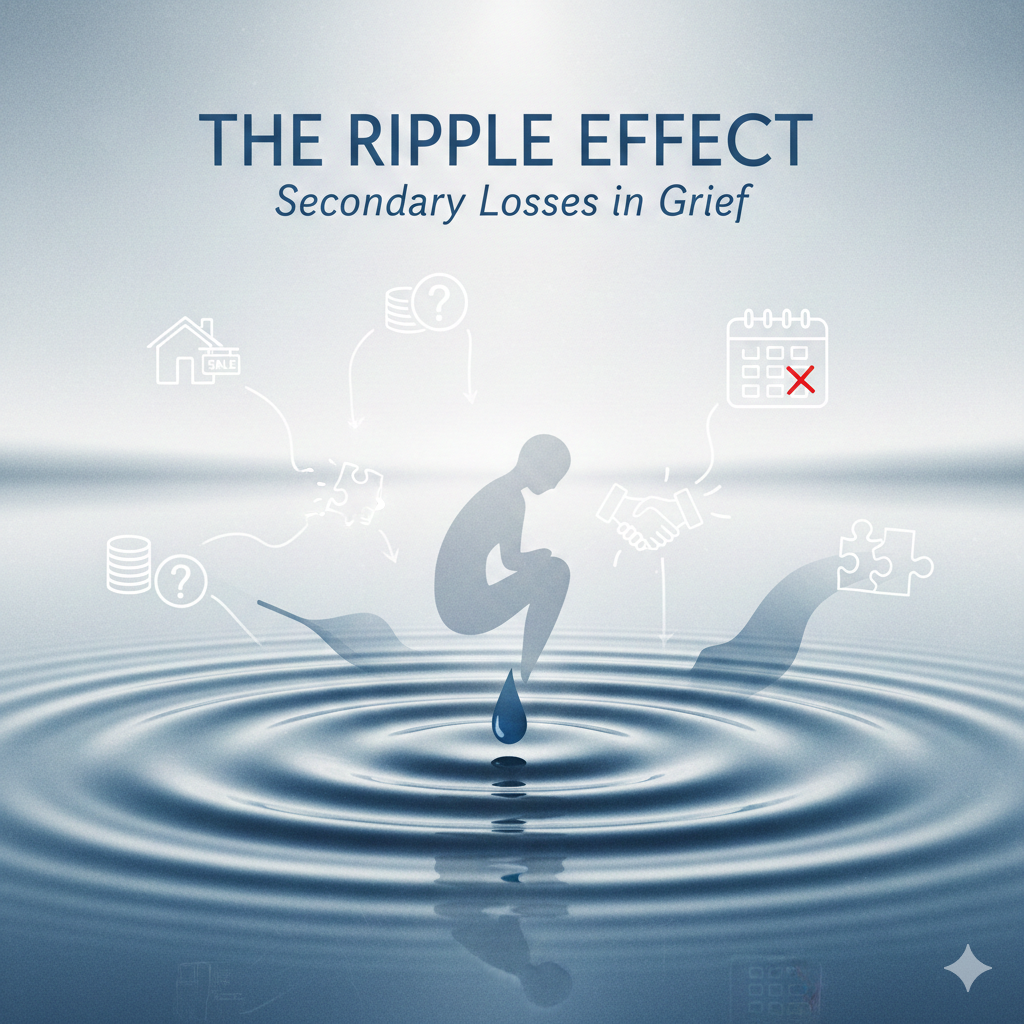
The Ripple Effect: Understanding Secondary Losses in Grief
The death is the obvious loss. What follows is less visible: the role you no longer hold, the friendships that fade, the shared future that vanishes, the sense that the world is predictable. Naming these secondary losses is a genuine step towards acknowledging and integrating your grief.
When we talk about grief, the primary loss—the death itself—is immediately obvious. However, the profound impact of grief is often magnified by what we call secondary losses. These are the non-death related losses that ripple out from the primary loss, fundamentally affecting our lives in a myriad of ways.
What are Secondary Losses?
A secondary loss is the loss of tangible or intangible elements of life that were connected to the deceased or their role. These can include:
Loss of Identity: The deceased may have been a spouse, a parent, a close friend, or a caretaker. When they are gone, the survivor loses the corresponding role: "spouse," "parent," "caregiver," or "friend." This may force a painful reconstruction of self.
Loss of Financial Security or Lifestyle: The income, insurance, or general financial contribution of the deceased can vanish, leading to stress and significant changes in how the survivor must live.
Loss of Social Circle or Support: Friendships maintained through the loved one may fade. Shared activities, traditions, and routines—like Saturday morning coffee or holiday planning—cease. We may feel like the proverbial “third wheel” and no longer belong. Further, deaths may affect familial relationships, increasing emotional intensity and conflict.
Loss of Dreams and Future Plans: The shared future the grieving person envisioned—retirement, a child's graduation, a special trip—is suddenly unattainable.
Loss of Trust: The death of a loved one can often challenge our worldview and shatter our beliefs that life is predictable or fair. We may feel unsafe in the world, become hypervigilant, and question relationships and support systems.
Acknowledging these losses is a crucial step towards coping with loss. As we cope, we integrate our grief and restore our capacity for well-being. Ultimately, this allows us to see possibilities for a promising future and navigate a life that is meaningful to us.
Grief - When Will I Feel Better?
It is the question I am asked most often as a grief therapist and the honest answer is unsatisfying at first. There are no stages, the process is not linear, and yet people genuinely do feel better over time. Here is what actually changes.
When we’re in the depths of grief, we can feel overwhelmed, unsteady, and rocked by deep emotion. It’s therefore understandable that one of the most common questions I get as a grief therapist is, “when will I feel better?” The answer can be unsatisfying because grief is not linear and there are no stages of grief (contrary to outdated “stages” espoused by Dr. Kubler-Ross). Rather, we each have a unique grief journey and while we ultimately learn to incorporate death and loss into a meaningful life, our grief never ends because our connection with our loved ones never ends. Having said all of this, people will feel “better” over time as they discover a balance between grieving their loss and living a fulfilling life.
The Importance of Continuing Bonds
Staying connected to someone after their death is not denial, and it is not a failure to move forward. Dreams, a felt sense of presence, striking coincidences, and talking to them are among the most natural and healthy parts of mourning.
The Importance of Continuing Bonds
You reach for your phone to text them before you remember. You talk to their photograph while the coffee brews. Something happens at work that only they would have found funny and you tell them about it out loud in the car on the way home.
And then, often, a second thought arrives. Is this normal? Should I still be doing this?
For most of the last century, the answer people absorbed from the culture around them was no. Grief was a process of letting go and someone still talking to a person who died two years ago had gotten stuck somewhere they should have moved past.
That turned out to be wrong and researchers have known it for thirty years. Most people never heard.
Why the Bond Does Not Simply Stop
Start with the biology, because it explains more than the theory does.
Human beings attach. Infants are born dependent on a caregiver for survival, and evolution built a loud alarm system to keep that caregiver close: protest when they leave, distress that does not resolve until they come back. That system does not switch off when we grow up. It stays online, attached now to a spouse, a parent, a child, the handful of people across a lifetime who become what attachment researchers call a secure base.
Which is why grief so often feels less like sadness and more like an emergency. It is protest. It is a nervous system that spent years, sometimes decades, organized around one person's reliable presence, still firing the alarm it evolved to fire, with no return that will ever satisfy it.
So when you catch yourself reaching for the phone, that is not a failure to accept anything. That is the system doing exactly what it was built to do.
Where the Old Idea Came From
The belief that grief means detachment has a specific origin. In 1917, Freud described mourning as the gradual withdrawal of emotional investment from the person who died, so that the energy tied up in that relationship could be freed and placed elsewhere. The goal was a clean severing. Someone still emotionally tied to a person who had died was, in that model, failing at the task.
That idea had an extraordinary reach. It shaped clinical training, popular advice, and the ordinary sense that moving forward requires letting go. It is where "closure" comes from, and why closure is a myth is the same argument from a different direction.
Then in 1996, Dennis Klass, Phyllis Silverman, and Steven Nickman brought together twenty-two researchers who had all noticed the same thing in their own work with bereaved people, from widows to grieving children. The resulting book found what the older model had missed. People who were grieving well did not sever the bond. They kept it, in changed form, indefinitely.
What changes after a death is not whether the relationship exists. It is the shape it takes.
The Things That Happen to You
Some of this arrives on its own, and those are the experiences people are most afraid to mention.
Dreams. These are often vivid in a way ordinary dreams are not. Some people wake comforted, having had a few seconds of the person being alive and ordinary. Others wake devastated by the moment of remembering again. Some are troubled instead by the absence of these dreams, waiting for a visit that never comes and wondering what it says about the relationship. It says nothing. Dream recall varies enormously between people, and it shifts with sleep quality, which grief disrupts badly on its own.
A sense of their presence. The feeling that someone is in the room. A familiar scent with no source. Your name in their voice in the half second before waking.
In 1971, a Welsh physician named Dewi Rees interviewed 227 widows and 66 widowers in his own practice and found that almost half reported experiences of this kind. The most common by far was a felt sense of presence, reported by roughly four in ten. He concluded they were normal and, for most people, helpful. Reviews since have found the same thing consistently.
One number from that study matters more than the prevalence figure. Fewer than three in ten of the people who had these experiences had ever mentioned them to anyone at all. They were afraid of being ridiculed or felt the experience was too private to say out loud.
So this is not rare. It is nearly silent. Which is exactly why each person having it concludes they are the only one.
If you have had one of these and never told a soul, you can put that particular worry down. And if you have never had one, that means nothing about your grief either.
What a Bond Actually Is
Here is the distinction that matters and it is the reason the section above is short.
None of those experiences is a continuing bond. They happen to you. You cannot summon them, you cannot schedule them, and for a great many grieving people they never arrive at all. Something that visits you unbidden cannot be the thing you are asked to build.
A bond is not something that visits. It is something you keep.
That is good news because it means this is not a matter of luck or temperament or whether you are the sort of person who dreams vividly. It is a matter of what you choose to do.
What You Can Actually Do
Talk to them. Out loud in the kitchen, silently in the car. Ask their advice about a decision and notice that you already know what they would say, because you knew how they thought. This is the most common form the bond takes and the one people are quickest to apologize for. There is nothing to apologize for.
Say their name to other people. Keep them in your sentences. Bring them up at dinner. This is the practice most often shut down by everyone around you, who go quiet or change the subject because they are afraid of upsetting you. You are allowed to be the one who brings them up, and doing it once usually gives the people around you permission they did not know they had.
Build a ritual. A candle on a birthday. Their recipe at the holiday. A walk somewhere that was theirs. Rituals work because they give the bond a container: a designated time and shape, rather than a feeling that has to be managed continuously.
Keep the objects, on your own schedule. The watch, the sweater still in the closet, the handwriting on a grocery list. There is no correct timeline for any of this and no one else gets to set one for you.
Carry the values forward. Notice their generosity in how you treat a stranger. Catch yourself saying something they used to say. Make a decision the way they would have made it. This is the most durable form the bond takes, because it lives in who you are becoming rather than in something that can be lost or broken.
Use the practices of your tradition, if you have one. Prayer, a mass said in their name, a belief about where they are now. These frameworks carried continuing bonds for most of human history, long before anyone gave the idea a name.
The Honest Complication
Continuing bonds are not universally protective and a post that told you otherwise would be inaccurate.
Researchers still disagree about which forms help and which ones cost something and I would rather say that plainly than hand you a tidier answer than the evidence supports. Two things do seem to hold. Bonds tend to be harder to carry when the relationship itself was conflicted or dependent while the person was alive. And what matters is less how often you do something than which direction it points.
So the questions worth asking are these. Does this let you return to your life afterward or does it pull you out of it? Does it hold both the love and the death, or does it need the death to stay unreal?
That last one is the distinction that matters most. Avoidance feels like refusing reality, an insistence that nothing has really changed. A continuing bond feels different from the inside. It has already absorbed the fact of the death and found a way to persist anyway.
Technology has sharpened this. Griefbots, trained on a person's messages and voice, can now answer back. I have written about the digital afterlife and where that line falls. An imagined conversation is an ordinary continuing bond. A simulation that responds is a different thing, and it can quietly make the finality harder to absorb.
If your bond feels less like connection and more like a place you cannot leave, that deserves attention rather than judgment. If you are wondering whether you are stuck, the question is worth a real answer rather than an anxious loop.
Carrying Them Forward
What continuing bonds offers is not permission to hold on in defiance of moving forward. It is a more accurate description of what actually happens, and an invitation to do it deliberately rather than by accident.
You do not detach. You find, gradually, that the person you lost has become part of how you see, what you value, and how you move through a day. That is what grief integration actually looks like: not grief ending, but a life growing large enough to hold both the loss and everything still ahead of you.
So talk to them. Say the name at dinner. Keep the sweater. Cook the recipe on the day.
None of that is a failure to move forward. It is the relationship continuing, in the only form still available to it, which is the form you carry.
If you are grieving and finding this harder to navigate alone than you expected, I would be glad to talk. I offer a free 15-minute consultation. No pressure and no commitment, just a conversation.
